Volunteers Discover Rare Space Weather Events Using Their Ears
A citizen science project by NASA has led volunteers to discover unexpected patterns in plasma waves related to space weather. By translating magnetic field data into sound, participants identified anomalies that challenge previous scientific expectations. This innovative approach not only enhances understanding of geomagnetic storms but also engages the public in scientific research.
At a glance
Location and topic
Region
USA
Tag cluster
Trend count
+10 related briefs
What happened
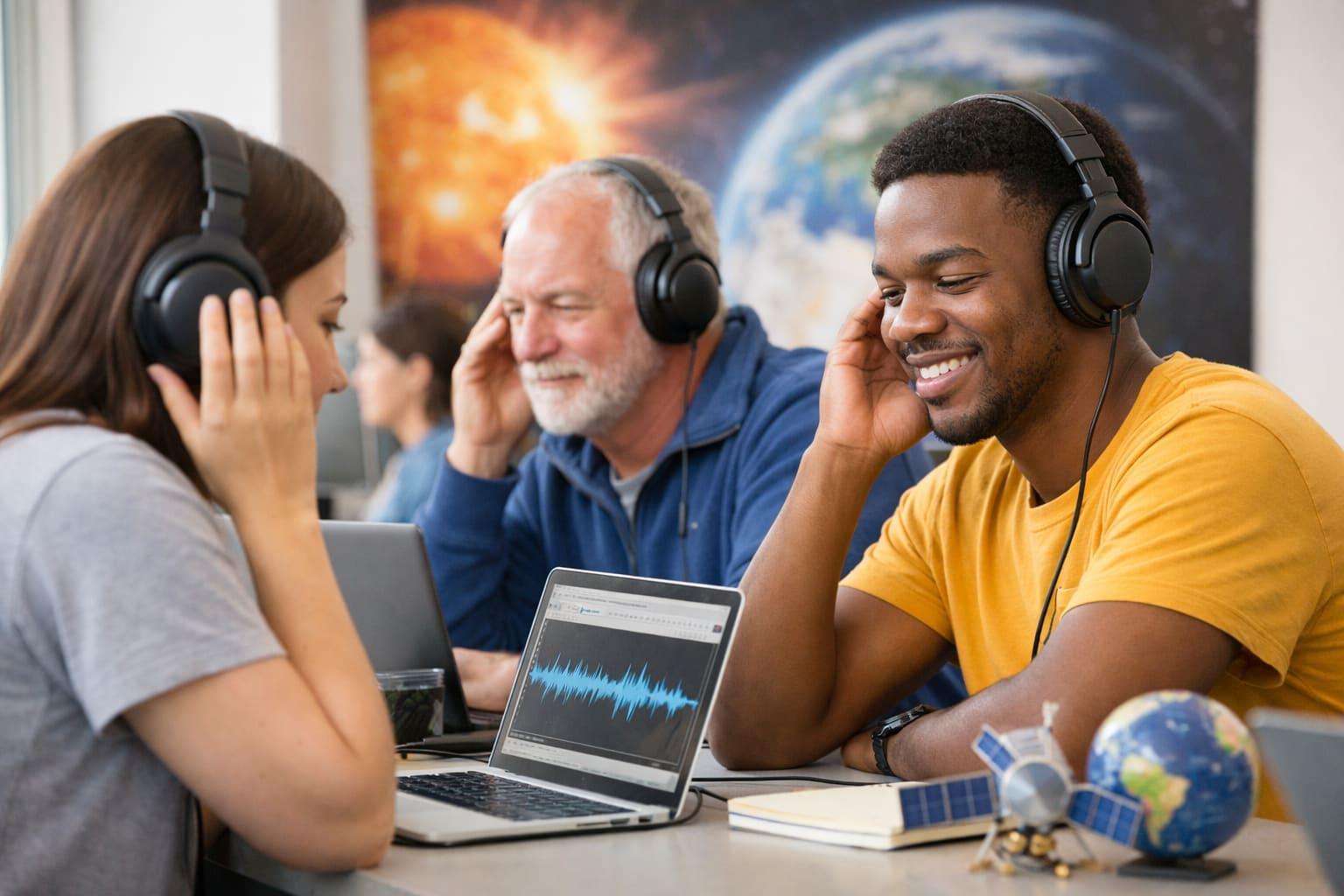
NASA's Heliophysics Audified: Resonances in Plasmas (HARP) project has opened a new frontier in space weather research by allowing volunteers to listen to plasma waves generated by the Earth's magnetic field. This innovative citizen science initiative translates magnetic field measurements into sound, enabling participants to engage with complex scientific phenomena in a unique way. The project specifically focuses on understanding plasma waves, which are crucial for comprehending space weather events that can impact technology on Earth, such as satellite operations and power grid stability. During the project, volunteers analyzed data from NASA's THEMIS (Time History of Events and Macroscale Interactions during Substorms) mission. They were tasked with identifying patterns in the frequencies of plasma waves. Surprisingly, the results contradicted the team's initial expectations: instead of the anticipated lower pitches farther from Earth and higher pitches closer to it, some plasma waves exhibited lower frequencies near Earth and higher frequencies at greater distances. This anomaly has significant implications for understanding the behavior of plasma waves during geomagnetic storms, which can disrupt communication systems and power grids. The excitement among volunteers was palpable, with one participant expressing a newfound passion for physics, stating, "I only signed up for this group because my friend was participating, but now I think I'm going to change my major to physics—this was just too cool." The HARP project not only contributes to scientific knowledge but also empowers individuals to take part in research that was once the sole domain of professional scientists. The findings from this project have been documented in a new article published in Frontiers in Astronomy and Space Sciences, highlighting the importance of citizen science in advancing our understanding of space weather.
Why this matters
The study of plasma waves and their behavior is essential for predicting space weather events that can have far-reaching effects on Earth. These events can disrupt satellite communications, GPS systems, and even power grids, making it crucial for scientists to understand how these waves interact with the Earth's magnetic field. The HARP project exemplifies the power of citizen involvement in scientific research, demonstrating that non-professionals can contribute valuable insights that challenge existing theories. By engaging the public in this way, NASA not only enhances scientific understanding but also fosters a greater appreciation for space science among participants. This initiative bridges the gap between professional researchers and the public, encouraging a collaborative approach to scientific discovery that can lead to significant advancements in the field.
What changed
The HARP project represents a paradigm shift in how space weather research is conducted by integrating citizen scientists into the scientific process. This approach has yielded unexpected results that may prompt a reevaluation of existing models of plasma wave behavior. The findings challenge long-held assumptions about the relationship between plasma wave frequencies and their distance from Earth, suggesting that current theories may need to be revised. Furthermore, the project has demonstrated the value of public participation in research, highlighting how diverse perspectives can lead to new insights and discoveries. As a result, the HARP initiative not only contributes to scientific knowledge but also sets a precedent for future research projects that seek to involve the public in meaningful ways.
Bigger picture
The integration of citizen science into research projects like HARP reflects a growing trend within the scientific community, where public engagement is increasingly recognized as a valuable asset. This model democratizes science, allowing individuals from various backgrounds to contribute to research efforts and enhancing the quality of scientific inquiry by incorporating diverse perspectives and skills. As technology continues to advance, the potential for citizen scientists to contribute to various fields—including environmental science, health research, and astronomy—expands significantly. This shift not only fosters a more informed and engaged public but also encourages collaboration between professional scientists and community members. The success of the HARP project may inspire similar initiatives in other scientific domains, potentially leading to a more collaborative and inclusive approach to research. As citizen science continues to evolve, it has the potential to transform how scientific knowledge is generated and disseminated, paving the way for innovative discoveries that benefit society as a whole.
Looking Towards the Future
As the HARP project progresses, future developments may provide deeper insights into the implications of the unexpected findings on space weather predictions. Researchers will likely continue to analyze the data collected by volunteers, which could lead to new models for understanding plasma wave behavior. Additionally, the success of this citizen science initiative could inspire similar projects across various scientific fields, promoting collaborative research efforts that harness the power of public engagement. Observers should keep an eye on how the findings from HARP influence future studies in space weather and whether they lead to advancements in technology designed to mitigate the impacts of geomagnetic storms.
Story timeline
HARP Project Launch
NASA launched the Heliophysics Audified: Resonances in Plasmas (HARP) project to engage volunteers in space weather research.
First Volunteer Contributions
Volunteers began analyzing audio data from the project, translating magnetic field measurements into sound.
Unexpected Findings
Volunteers discovered anomalies in plasma wave frequencies, challenging existing scientific expectations.
Sources behind this brief
2 total
Phys.org RSS
Original article on the discovery by volunteers.
Spaceflight News API
Corroborating source detailing the volunteer findings.
Further reading on this topic
4 links
NASA
An overview of the HARP project, detailing its objectives and how volunteers can participate in analyzing plasma waves.
NASA
An article discussing the HARP project's approach to converting magnetic field measurements into sound and its citizen science component.
NASA
Information about the science behind the HARP project and its methodology for analyzing plasma data.
NASA
A video introduction to the HARP citizen science project, explaining its purpose and how individuals can get involved.
Context zone
USA
Context zone
USA
On this map
Volunteers Discover Rare Space Weather Events Using Their Ears
USA
DESI Completes Largest 3D Map of the Universe
USA
The Dark Energy Spectroscopic Instrument (DESI) has successfully completed the largest high-resolution 3D map of the universe, capturing data from over 47 million galaxies and quasars. This achievement allows researchers to investigate dark energy's role in cosmic expansion, with early results suggesting it may evolve over time. The project, involving over 900 researchers globally, will continue to analyze the data and expand the survey to refine measurements of dark energy and the universe's structure.
NASA’s Perseverance, Curiosity Panoramas Capture Two Sides of Mars
United States
NASA's Curiosity and Perseverance rovers have unveiled stunning 360-degree panoramas of Mars, showcasing the planet's diverse geological history. Curiosity explores younger terrains while Perseverance investigates some of the oldest landscapes, revealing insights into Mars' past and potential for life. These images highlight the rovers' contributions to understanding the Red Planet's formation and ancient environments.
NASA’s Hubble Dazzles With Young Stars in Trifid Nebula
USA
NASA celebrates the 36th anniversary of the Hubble Space Telescope with a stunning new image of the Trifid Nebula, showcasing its vibrant star-forming region. The telescope's advanced capabilities allow for detailed observations of changes in the nebula over time, revealing the dynamic processes of star formation. This latest image highlights the impact of massive stars on their surroundings, triggering new waves of star birth.
Artemis II astronauts say landing on the Moon is "absolutely doable" soon
United States
The Artemis II crew expressed confidence in landing on the Moon, stating it is 'absolutely doable' following their successful mission. The astronauts, energized by NASA's plans for a lunar base, highlighted their readiness for future lunar operations. Their mission marked a significant step in NASA's Artemis program, aiming for sustained human presence on the Moon.
Roman Space Telescope Launching in September
USA
NASA has announced that the Nancy Grace Roman Space Telescope is set to launch in September 2026, ahead of schedule and under budget. This telescope will complement the James Webb Space Telescope by surveying the universe broadly, identifying targets for more detailed examination. Named after NASA's first Chief of Astronomy, Nancy Grace Roman, the telescope aims to uncover new insights about the universe, including the nature of dark energy and the expansion of the cosmos.
NASA’s Webb Redefines Dividing Line Between Planets, Stars
USA
NASA's James Webb Space Telescope has provided new insights into the formation of massive celestial bodies, specifically 29 Cygni b, which weighs 15 times that of Jupiter. The findings suggest that this object formed through a process of accretion within a protoplanetary disk, rather than through gas fragmentation, challenging previous assumptions about the formation of such massive planets. This research enhances our understanding of planetary formation and the characteristics that distinguish planets from stars.