Volunteers Discover Rare Space Weather Events Using Their Ears
NASA's HARP project has engaged volunteers to listen to space weather phenomena, leading to unexpected discoveries about plasma waves. Participants translated magnetic field data into sound, revealing anomalies in wave patterns that challenge previous scientific expectations. This citizen science initiative not only enhances understanding of space weather but also inspires participants to pursue scientific careers.
At a glance
Location and topic
Region
USA
Tag cluster
Trend count
+7 related briefs
What happened
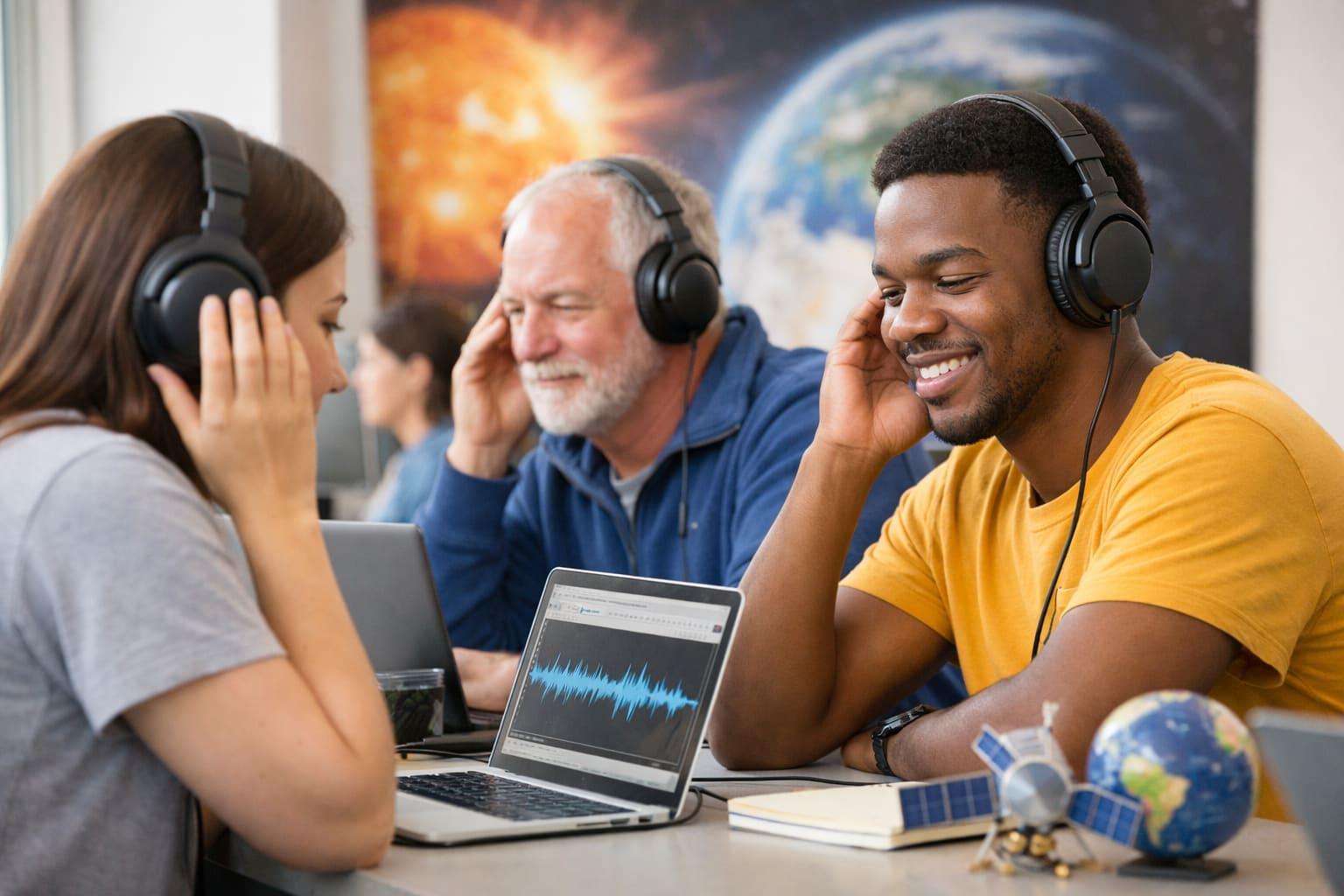
NASA's Heliophysics Audified: Resonances in Plasmas (HARP) project has engaged volunteers in a groundbreaking approach to studying space weather phenomena. By translating magnetic field measurements into sound, the project allows participants to listen to plasma waves, which are critical in understanding the dynamics of space weather. This innovative method has led to unexpected discoveries regarding the behavior of these waves. Volunteers, using data from NASA's THEMIS (Time History of Events and Macroscale Interactions during Substorms) mission, found that some plasma waves exhibited lower frequencies closer to Earth, which contradicts the previously held expectation that frequencies would be higher near the planet and decrease with distance. This anomaly is significant as it provides new insights into the behavior of plasma waves during geomagnetic storms, which can have profound effects on Earth's power grid and communication systems. The findings from the HARP project have been documented in a recent article published in Frontiers in Astronomy and Space Sciences, highlighting the contributions of citizen scientists in advancing our understanding of space weather. One enthusiastic volunteer remarked on the transformative experience, stating, "I only signed up for this group because my friend was participating, but now I think I'm going to change my major to physics—this was just too cool." This sentiment reflects the project's ability to inspire a new generation of scientists and enthusiasts, showcasing the power of citizen science in uncovering complex scientific phenomena.
Why this matters
Understanding the behavior of plasma waves is crucial for predicting geomagnetic storms, which can disrupt communication systems, navigation, and power grids on Earth. The HARP project not only contributes to scientific knowledge but also empowers individuals to engage with complex scientific concepts in a hands-on manner. By involving volunteers in the analysis of space weather data, the project fosters a deeper appreciation for the intricacies of space science and its relevance to everyday life. The ability to translate magnetic field data into sound allows participants to experience the phenomena in a unique way, making the science more accessible and engaging. This initiative highlights the importance of public participation in advancing scientific research, as it not only enhances the data collection process but also democratizes science, allowing individuals from diverse backgrounds to contribute to significant discoveries. The excitement generated among volunteers can lead to increased interest in STEM (science, technology, engineering, and mathematics) fields, ultimately benefiting the scientific community and society as a whole.
What changed
The HARP project represents a paradigm shift in how space weather research can be conducted by incorporating citizen scientists into the scientific process. This collaborative approach has led to the discovery of unexpected plasma wave patterns, prompting a reevaluation of existing theories in space physics. The findings challenge previous assumptions about the behavior of plasma waves and may lead to new research directions in understanding space weather phenomena. The enthusiasm and engagement of volunteers have not only contributed to the project's success but have also sparked interest in pursuing careers in science among participants. This shift towards citizen involvement in scientific research is indicative of a broader trend in the scientific community, where public engagement is increasingly recognized as a valuable asset in data collection and analysis. The HARP project exemplifies how citizen science can enhance scientific inquiry and lead to meaningful discoveries that may have otherwise gone unnoticed.
Bigger picture
The HARP project is part of a broader trend in science that emphasizes the role of citizen engagement in research. As technology advances, more projects are leveraging public participation to gather data and insights that were previously unattainable. This shift not only enhances scientific understanding but also fosters a sense of community and shared purpose in tackling complex global challenges, such as climate change and space weather. The findings from HARP could influence future research directions and policies related to space exploration and Earth sciences. By involving volunteers in the scientific process, projects like HARP democratize science, allowing individuals from various backgrounds to contribute to significant discoveries. This approach can lead to a more informed public, capable of understanding and engaging with scientific issues that affect their lives. Furthermore, the success of the HARP project may inspire similar initiatives in other fields, encouraging a culture of collaboration between scientists and the public. As citizen science continues to grow, it has the potential to reshape the landscape of scientific research, making it more inclusive and responsive to societal needs. The implications of these findings on technology and infrastructure resilience against geomagnetic storms will be crucial, as understanding space weather becomes increasingly important in our technology-driven world.
Looking Towards the Future
Future developments from the HARP project may lead to new research publications and insights into space weather phenomena, particularly regarding the implications of the newly discovered plasma wave patterns. Observers should also watch for increased public interest in citizen science initiatives, as they can significantly contribute to scientific advancements and foster a greater understanding of complex scientific concepts. Additionally, the implications of these findings on technology and infrastructure resilience against geomagnetic storms will be crucial, especially as society becomes more reliant on technology that can be affected by space weather. The ongoing analysis of data collected by HARP volunteers may yield further surprises, potentially reshaping our understanding of the interactions between solar activity and Earth's magnetic field.
Story timeline
HARP Project Launch
NASA launched the HARP project to engage volunteers in studying space weather.
First Volunteer Data Collection
Volunteers began collecting and analyzing data from the HARP project.
Unexpected Findings Reported
Volunteers reported unexpected plasma wave patterns, leading to new scientific insights.
Sources behind this brief
2 total
Phys.org
Original article detailing the HARP project and its findings.
Spaceflight News API
Corroborating source highlighting the volunteer contributions to the HARP project.
Further reading on this topic
2 links
Context zone
USA
Context zone
USA
On this map
Volunteers Discover Rare Space Weather Events Using Their Ears
USA
DESI Completes Largest 3D Map of the Universe
USA
The Dark Energy Spectroscopic Instrument (DESI) has successfully completed the largest high-resolution 3D map of the universe, capturing data from over 47 million galaxies and quasars. This achievement allows researchers to investigate dark energy's role in cosmic expansion, with early results suggesting it may evolve over time. The project, involving over 900 researchers globally, will continue to analyze the data and expand the survey to refine measurements of dark energy and the universe's structure.
Astronauts Experience Awe-Inspiring Solar Eclipse from Lunar Orbit
United States
During the Artemis II mission, astronauts witnessed a total solar eclipse from lunar orbit, marking a historic first. This unique perspective allowed them to see the moon completely obscuring the sun, with Earthshine illuminating the lunar surface. Such experiences can profoundly impact astronauts' perceptions of their place in the universe.
NASA’s Perseverance, Curiosity Panoramas Capture Two Sides of Mars
United States
NASA's Curiosity and Perseverance rovers have unveiled stunning 360-degree panoramas of Mars, showcasing the planet's diverse geological history. Curiosity explores younger terrains while Perseverance investigates some of the oldest landscapes, revealing insights into Mars' past and potential for life. These images highlight the rovers' contributions to understanding the Red Planet's formation and ancient environments.
Roman Space Telescope Launching in September
USA
NASA has announced that the Nancy Grace Roman Space Telescope is set to launch in September 2026, ahead of schedule and under budget. This telescope will complement the James Webb Space Telescope by surveying the universe broadly, identifying targets for more detailed examination. Named after NASA's first Chief of Astronomy, Nancy Grace Roman, the telescope aims to uncover new insights about the universe, including the nature of dark energy and the expansion of the cosmos.
NASA’s Hubble Dazzles With Young Stars in Trifid Nebula
USA
NASA celebrates the 36th anniversary of the Hubble Space Telescope with a stunning new image of the Trifid Nebula, showcasing its vibrant star-forming region. The telescope's advanced capabilities allow for detailed observations of changes in the nebula over time, revealing the dynamic processes of star formation. This latest image highlights the impact of massive stars on their surroundings, triggering new waves of star birth.
NASA’s Curiosity Finds Organic Molecules Never Seen Before on Mars
United States
NASA's Curiosity rover has discovered the most diverse collection of organic molecules on Mars, including seven never seen before. This significant finding suggests that ancient Mars had the right chemistry to support life. The results were published in Nature Communications, highlighting the potential for future exploration and understanding of Martian chemistry.