NASA’s Perseverance, Curiosity Panoramas Capture Two Sides of Mars
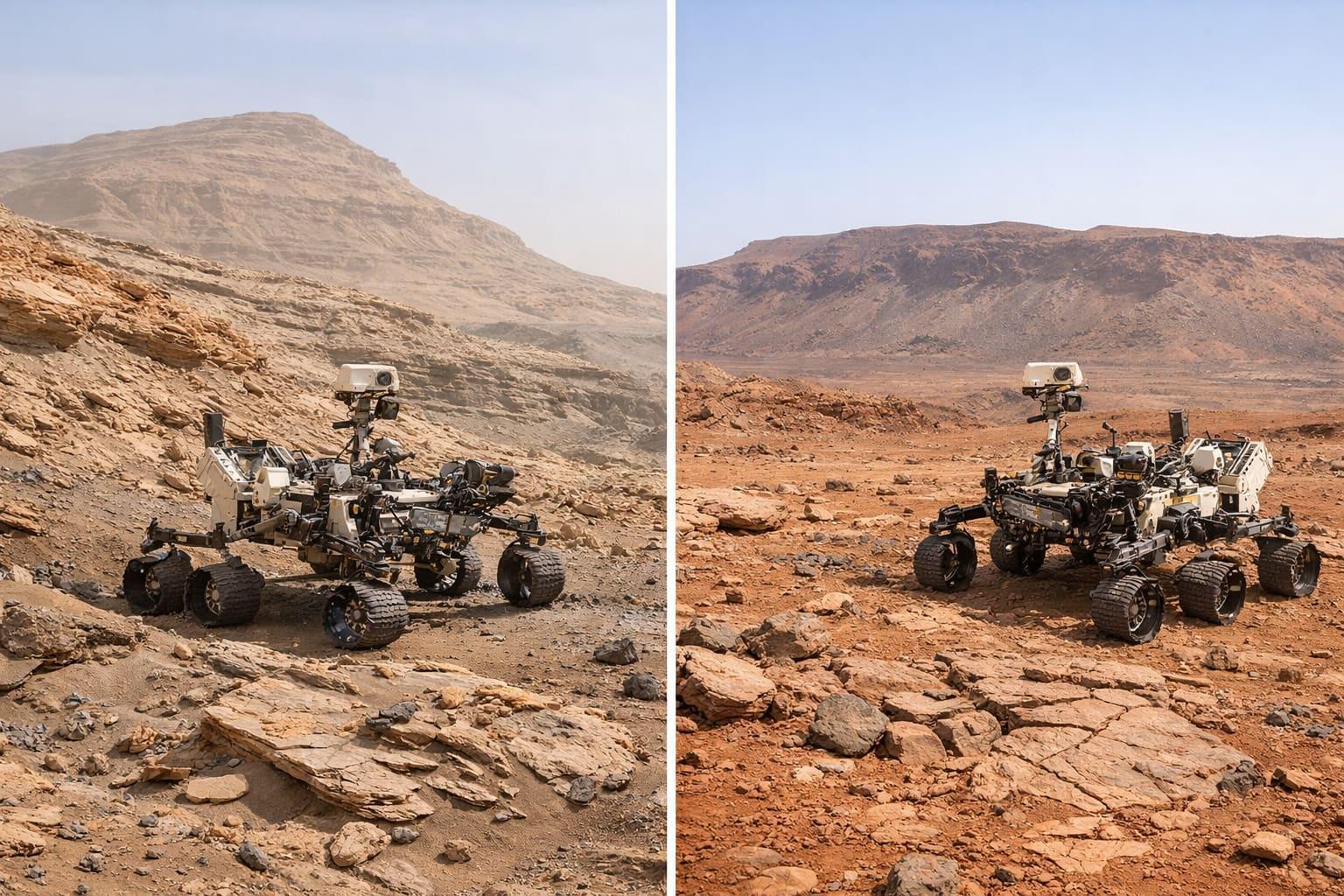
NASA's Curiosity and Perseverance rovers have unveiled stunning 360-degree panoramas of Mars, showcasing the planet's diverse geological history. Curiosity explores younger terrains while Perseverance investigates some of the oldest landscapes, revealing insights into Mars' past and potential for life. These images highlight the rovers' contributions to understanding the Red Planet's formation and ancient environments.
At a glance
Location and topic
Region
United States
Tag cluster
Trend count
+12 related briefs
What happened
NASA's Curiosity and Perseverance rovers have recently unveiled stunning 360-degree panoramas of Mars, showcasing two distinct geological landscapes that highlight the planet's complex history. Curiosity, operational since 2012, is currently exploring the foothills of Mount Sharp, while Perseverance, which landed in 2021, is investigating the ancient Jezero Crater. The two rovers are positioned 2,345 miles apart, roughly the distance from Los Angeles to Washington, D.C., allowing them to provide complementary insights into Mars' geological evolution. Curiosity's panorama, created from over 1,000 images taken between November 9 and December 7, 2025, showcases a region filled with boxwork formations—low ridges formed by ancient groundwater activity that once flowed through fractures in the bedrock. These formations resemble giant spiderwebs in orbiter images and are significant for understanding the planet's past hydrological processes. Meanwhile, Perseverance's panorama, compiled from 980 images taken between December 18, 2025, and January 25, 2026, focuses on the Jezero Crater's rim and its ancient rocks, which are believed to hold clues about the planet's early environment and the potential for life. Both rovers are contributing to a deeper understanding of Mars' past, including its watery history and the conditions that may have supported microbial life. Curiosity has been ascending Mount Sharp, which is 3 miles high and formed from layers of sediment deposited in ancient lakes, while Perseverance is examining the crater's floor, where sediments from a river that once fed a lake may have preserved traces of ancient life. The findings from these missions are expected to enhance our knowledge of Mars and inform future exploration efforts.
Why this matters
The exploration of Mars by Curiosity and Perseverance is crucial for understanding the planet's geological history and assessing its potential to support life. These missions provide valuable data that could inform future explorations and the search for extraterrestrial life. The insights gained from these rovers may also have implications for understanding planetary processes more broadly. For instance, the discovery of organic molecules and the analysis of ancient rock formations can help scientists understand the conditions that led to the development of life on Earth and potentially elsewhere in the universe. As we learn more about Mars' past, we can better assess the likelihood of finding life beyond our planet, which is a fundamental question in astrobiology. Furthermore, the technological advancements demonstrated by these missions, such as high-resolution imaging and sample collection techniques, set the stage for future missions that may involve returning samples to Earth for more detailed analysis. This ongoing research is not only significant for Mars but also for the broader field of planetary science, as it helps to refine our understanding of how terrestrial planets evolve over time.
What changed
The recent panoramas taken by Curiosity and Perseverance represent a significant advancement in our ability to visualize and understand Mars' diverse landscapes. These images not only enhance our knowledge of the planet's geological history but also demonstrate the technological capabilities of modern space exploration. The ability to stitch together thousands of images into comprehensive panoramas allows scientists and the public alike to engage with Mars in a more meaningful way, fostering a deeper appreciation for the complexities of its environment. As the rovers continue their missions, they are expected to provide even more detailed data that could lead to groundbreaking discoveries. For example, Curiosity's recent findings of diverse organic molecules and Perseverance's exploration of ancient sedimentary rocks are pivotal in piecing together the planet's history. The ongoing analysis of these samples will likely yield new insights into the conditions that existed on Mars billions of years ago, potentially revealing whether life ever existed there. The advancements in imaging technology and data collection methods also pave the way for future missions, which may include more sophisticated rovers or even human exploration, further expanding our understanding of Mars and its potential for habitability.
Bigger picture
The ongoing exploration of Mars by NASA's rovers is part of a larger effort to understand the potential for life beyond Earth. As scientists analyze the data collected from these missions, they are piecing together a narrative of Mars' past that includes the presence of water and the conditions that may have supported life. This research is not only significant for Mars but also for understanding the broader context of planetary science and the evolution of terrestrial planets. The findings from these missions could influence future exploration strategies and the design of missions aimed at searching for life on other planets. For instance, the discoveries made by Curiosity and Perseverance may inform the selection of landing sites for future missions, including those that aim to return samples to Earth. Additionally, the insights gained from Mars exploration can provide valuable lessons for understanding the geological and atmospheric processes that shape other celestial bodies, including exoplanets. As we continue to explore Mars, we are not only uncovering the secrets of our neighboring planet but also expanding our knowledge of the universe and our place within it. The implications of these discoveries extend beyond scientific curiosity; they may also inspire future generations to pursue careers in science, technology, engineering, and mathematics (STEM), fostering a new wave of innovation and exploration.
History
NASA's exploration of Mars has a rich history, beginning with the Mariner missions in the 1960s, which provided the first close-up images of the planet. This was followed by a series of landers and orbiters that laid the groundwork for our understanding of Mars' geology and atmosphere. The Curiosity rover, which landed in 2012, has been pivotal in discovering evidence of past water on Mars, including the identification of ancient lakebeds and minerals that suggest a once-wet environment. Curiosity's findings have significantly advanced our understanding of the planet's potential to support life. Perseverance, which landed in 2021, is focused on astrobiology and the search for signs of ancient life, building on the discoveries made by its predecessor. These missions build on decades of research and exploration, contributing to our understanding of Mars as a potentially habitable world. The ongoing work of these rovers is a testament to the advancements in technology and our commitment to exploring the cosmos, as we seek to answer fundamental questions about life beyond Earth.
Looking Towards the Future
As both Curiosity and Perseverance continue their explorations, keep an eye on upcoming discoveries related to Mars' geological history and potential signs of past life. Future updates from NASA will likely highlight significant findings from these missions, including analyses of rock samples and new insights into the planet's climate and environment. Additionally, the ongoing advancements in rover technology may lead to even more detailed explorations in the coming years. For instance, the upcoming analysis of the samples collected by Perseverance could provide groundbreaking insights into the planet's ancient biosphere. Furthermore, as both rovers continue to traverse their respective terrains, they may uncover new geological features that could reshape our understanding of Mars' history. The scientific community and the public alike are eagerly awaiting the next set of revelations from these missions, which promise to deepen our understanding of the Red Planet and its potential for life.
Story timeline
Spaceflight News
NASA’s Perseverance, Curiosity Panoramas Capture Two Sides of Mars
Curiosity Lands on Mars
Curiosity rover successfully lands on Mars to explore Gale Crater.
Perseverance Lands on Mars
Perseverance rover lands in Jezero Crater to search for signs of ancient life.
Curiosity's Significant Discoveries
Curiosity discovers organic molecules and evidence of ancient water on Mars.
Sources behind this brief
2 total
Spaceflight News
New corroborating reporting on this story
Jet Propulsion Laboratory
Information on the management and operations of the Mars rovers.
Further reading on this topic
3 links
NASA Jet Propulsion Laboratory
Official announcement detailing the latest panoramic images captured by Curiosity and Perseverance rovers.
NASA
Insights into Curiosity's exploration of Mars' changing landscape and geological history.
NASA
Information on Curiosity's highest-resolution panorama capturing Martian terrain.
Context zone
United States
Context zone
United States
On this map
NASA’s Perseverance, Curiosity Panoramas Capture Two Sides of Mars
United States
Every dollar spent on forest fuel treatments saves $3.75 in wildfire damages, study finds
United States
A recent study from UC Davis reveals that investing in forest fuel treatments, such as thinning and prescribed burns, can save $3.75 for every dollar spent by preventing wildfire damages. The research analyzed nearly 300 wildfires across the western United States and found that these treatments significantly reduced wildfire spread and severity, preventing an estimated $2.8 billion in damages. The findings highlight the importance of investing in preventive forest management to mitigate the increasing risks of wildfires due to climate change.
Florida baby ‘born twice’ after elaborate surgery involving partial delivery
Orlando, United States
Cassian Joubert, a Florida infant, underwent a groundbreaking surgery that involved a partial delivery to save his life. This innovative procedure allowed doctors to create an airway for him while still in the womb, leading to his eventual birth. The Jouberts celebrate Cassian's unique journey with two birthdays, marking both his surgery and his birth.
Hundreds of animals rescued from ‘appalling’ conditions at California sanctuary
Julian, United States
Over 400 animals, including horses, cats, and dogs, were rescued from a California sanctuary facing bankruptcy and severe neglect. The San Diego Humane Society led the operation, uncovering widespread malnutrition and untreated injuries among the animals. This rescue highlights the ongoing challenges in animal welfare and the importance of vigilance in ensuring proper care.
US Supreme Court asked to restore abortion pill access
United States
Danco Laboratories has requested the US Supreme Court to intervene after a Fifth Circuit ruling reinstated in-person requirements for obtaining mifepristone, the abortion pill. This decision temporarily limits access to the medication, which has been available by mail since 2023. The case highlights ongoing tensions surrounding abortion access in the US, particularly in states with restrictive laws.
AI Outperforms Doctors in Harvard Trial of Emergency Triage Diagnoses
Boston, United States
A recent Harvard study reveals that AI systems have surpassed human doctors in emergency triage diagnoses, particularly in high-pressure situations. The AI demonstrated a significant advantage in accuracy, diagnosing correctly in 67% of cases compared to 50-55% for human doctors. This breakthrough suggests a transformative shift in medical technology, potentially reshaping the role of healthcare professionals in emergency settings.
New genome editing method could swap entire genes and correct 1000 mutations at once
United States
A groundbreaking genome editing technique allows for the insertion of large DNA segments, potentially correcting up to 1,000 mutations simultaneously. This method, termed 'prime assembly,' utilizes overlapping DNA flaps to avoid double-strand breaks, enhancing gene therapy applications. Researchers believe this innovation could revolutionize treatments for genetic disorders by enabling comprehensive gene replacements.