NASA’s Roman Poised to Transform Hunt for Elusive Neutron Stars
NASA's upcoming Nancy Grace Roman Space Telescope is set to revolutionize the search for isolated neutron stars using astrometric microlensing. This innovative approach could allow astronomers to measure the mass of these elusive stellar remnants, which are typically difficult to detect. The telescope's capabilities may lead to significant advancements in our understanding of stellar evolution and the dynamics of the Milky Way.
At a glance
Location and topic
Region
USA
Tag cluster
Trend count
+7 related briefs
What happened
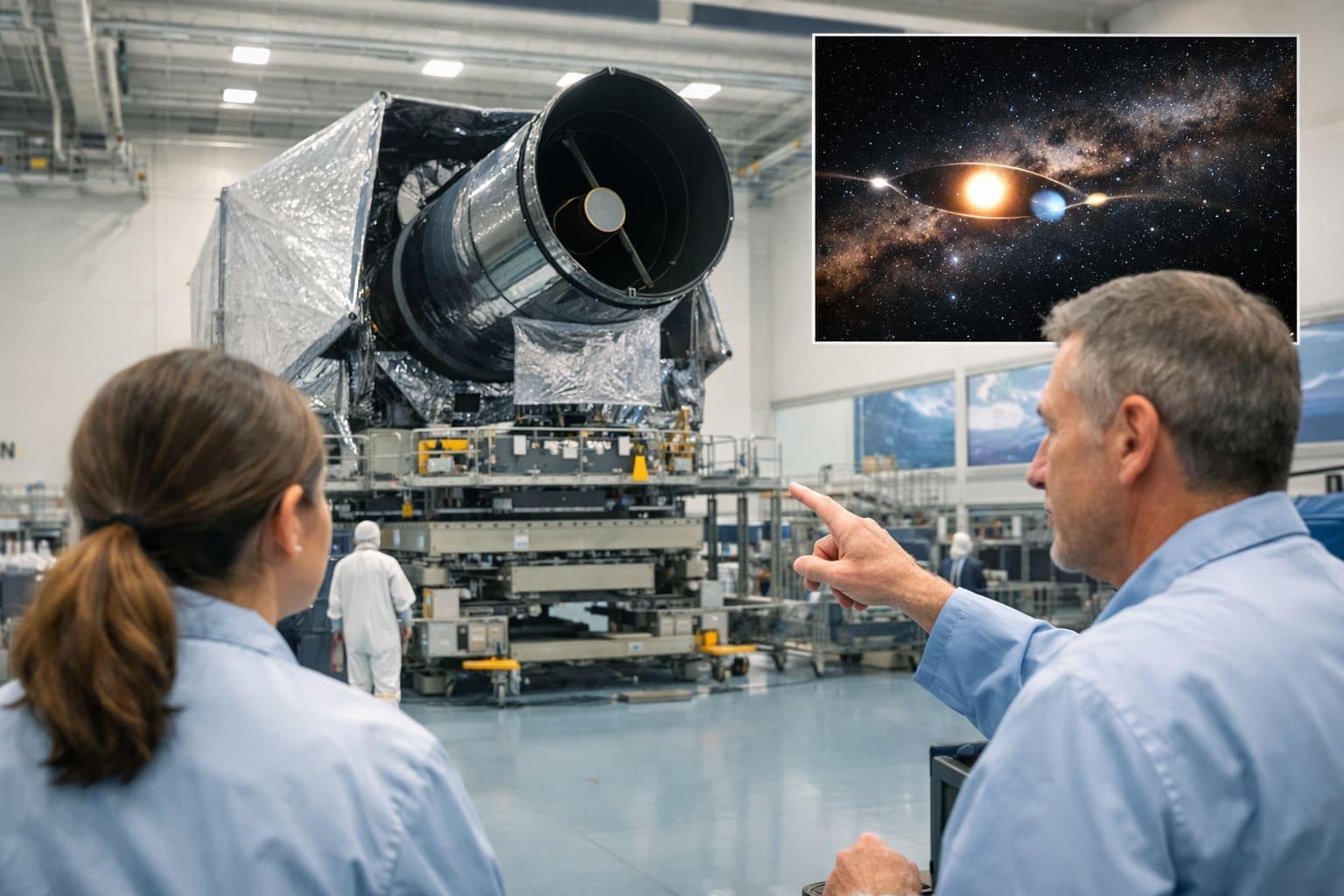
NASA's upcoming Nancy Grace Roman Space Telescope is set to significantly advance the search for isolated neutron stars, which are remnants of massive stars that have exploded. A recent study published in Astronomy and Astrophysics indicates that the telescope can utilize gravitational microlensing to identify and characterize these stars, which are typically dim and difficult to observe. The research team demonstrated that Roman's observations could reveal dozens of these elusive objects by analyzing the light from distant stars that is warped by the gravity of the neutron stars. Neutron stars, which pack more mass than the Sun into a city-sized sphere, are crucial for understanding stellar evolution and the distribution of heavy elements in the universe. The Roman Space Telescope will employ astrometric microlensing, a technique that measures the slight positional shifts of background stars caused by the gravitational influence of foreground neutron stars. This method allows astronomers to not only detect these stars but also to measure their masses, providing valuable data that has been challenging to obtain with existing telescopes. The study's lead author, Zofia Kaczmarek from Heidelberg University, emphasized the difficulty of spotting these neutron stars without assistance, stating, "Most neutron stars are relatively dim and on their own. They are incredibly hard to spot without some sort of help." The Roman Space Telescope's ability to measure both the brightness and the positional shift of lensed stars with exceptional precision is a game-changer. As a neutron star passes in front of a more distant star, its intense gravity warps spacetime, causing the background star's light to bend. This microlensing effect briefly makes the background star appear brighter and offset from its true position in the sky. The size of the positional shift can be used to infer the mass of the neutron star, allowing astronomers to gain insights into the mass distribution of these stellar remnants. The research team plans to utilize Roman's Galactic Bulge Time Domain Survey, which will monitor millions of stars at a time, to identify promising microlensing events. Even a small number of confirmed detections could significantly improve models of stellar explosions and extreme matter, as the current understanding of neutron star masses is limited to a few thousand detected, mostly in binary systems. The potential for Roman to discover isolated neutron stars represents a significant leap forward in astrophysical research, as Kaczmarek noted, "Even a single mass measurement would be very powerful."
Why this matters
The ability to detect and measure isolated neutron stars could lead to breakthroughs in our understanding of stellar evolution and the dynamics of the Milky Way. This research may also help clarify the mass distribution of neutron stars and black holes, which has implications for our understanding of the universe's structure. The Roman Space Telescope's innovative approach opens new avenues for astronomical research, potentially revealing a hidden population of neutron stars. Understanding the characteristics of these stars is essential for comprehending the life cycles of massive stars and the processes that govern the formation of heavy elements in the universe. The insights gained from Roman's observations could reshape existing theories about stellar remnants and their role in the cosmic landscape. Additionally, the findings could have broader implications for our understanding of gravitational waves, as neutron stars are often involved in the mergers that produce these phenomena. The Roman Space Telescope's capabilities may also enhance our knowledge of the evolution of galaxies, as neutron stars contribute to the chemical enrichment of the interstellar medium. Overall, the mission represents a significant step forward in the quest to unravel the mysteries of the universe and our place within it.
What changed
The introduction of the Roman Space Telescope marks a significant shift in astronomical research capabilities, particularly in the study of neutron stars. Previously, detecting these stars was limited to specific conditions, such as when they are part of binary systems or emit detectable radiation. With Roman's advanced astrometric capabilities, researchers can now explore a broader range of neutron stars, including those that have remained hidden from observation until now. This shift allows for a more comprehensive understanding of the population of neutron stars in the Milky Way, as the telescope's ability to measure mass through microlensing provides a new dimension to the study of these objects. The potential to identify isolated neutron stars and measure their masses directly is a groundbreaking development, as it could lead to a better understanding of the transition between neutron stars and black holes. The Roman Space Telescope's mission also highlights the importance of interdisciplinary collaboration, as it involves contributions from various institutions, including NASA's Goddard Space Flight Center, the Jet Propulsion Laboratory, and the Space Telescope Science Institute. This collaborative effort underscores the significance of the mission in advancing our knowledge of the universe and the fundamental processes that govern it.
Bigger picture
The Roman Space Telescope's mission aligns with a growing interest in understanding the fundamental processes that govern the universe. As astronomers seek to uncover the mysteries of dark matter, dark energy, and the life cycles of stars, the ability to detect isolated neutron stars will provide critical insights. This mission not only enhances our knowledge of stellar remnants but also contributes to the broader quest to understand the formation and evolution of galaxies. The potential discoveries from Roman could reshape our understanding of the cosmos and our place within it. The study of neutron stars is particularly relevant in the context of gravitational wave astronomy, as these dense remnants are often involved in the mergers that produce detectable gravitational waves. The insights gained from Roman's observations could inform our understanding of the frequency and characteristics of such events, further bridging the gap between electromagnetic and gravitational wave astronomy. Additionally, the Roman Space Telescope's capabilities may lead to the discovery of new astrophysical phenomena, as its innovative approach to microlensing opens the door to exploring previously uncharted territories in the universe. The mission's findings could have far-reaching implications for our understanding of the universe's structure, the formation of heavy elements, and the dynamics of stellar populations. As the scientific community eagerly anticipates the launch of the Roman Space Telescope, the potential for groundbreaking discoveries looms large, promising to deepen our understanding of the universe and the fundamental forces that shape it.
History
The study of neutron stars has evolved significantly since their discovery in the 1960s. Initially identified as pulsars, these dense remnants of supernova explosions have intrigued astronomers for decades. However, most neutron stars remain undetected due to their faintness and isolation. The development of advanced telescopes like the Roman Space Telescope represents a pivotal moment in astrophysics, enabling researchers to explore previously inaccessible aspects of stellar evolution and the dynamics of the Milky Way. The ability to measure the masses of isolated neutron stars through astrometric microlensing is a significant advancement, as it allows scientists to gather data that has been challenging to obtain with existing telescopes. Historically, the understanding of neutron stars has been limited to those that emit detectable radiation or are part of binary systems. The Roman Space Telescope's innovative approach promises to revolutionize this field of study, providing a more comprehensive view of the neutron star population in our galaxy and enhancing our understanding of the processes that govern stellar evolution.
Looking Towards the Future
As the Roman Space Telescope prepares for its launch, observers should keep an eye on its early data releases, which may include the first detections of isolated neutron stars. The telescope's Galactic Bulge Time Domain Survey will monitor millions of stars, providing a wealth of information that could lead to groundbreaking discoveries. Additionally, the scientific community will be eager to analyze the implications of any mass measurements obtained from these observations. The potential for Roman to uncover a hidden population of neutron stars could significantly enhance our understanding of stellar evolution and the dynamics of the Milky Way. Researchers will be particularly interested in how these findings may inform existing models of stellar explosions and the distribution of heavy elements in the universe. As the mission unfolds, the excitement surrounding the discoveries made by the Roman Space Telescope will likely inspire further research and exploration in the field of astrophysics.
Story timeline
Launch of Roman Space Telescope
The Nancy Grace Roman Space Telescope is set to launch, marking a new era in astronomical research.
First Data Release
The telescope will begin releasing its first observational data, potentially including neutron star detections.
Major Findings Announced
A year after launch, significant findings from the telescope's observations are expected to be announced.
Sources behind this brief
2 total
NASA
Original article on the Roman Space Telescope's capabilities.
Phys.org
Corroborating source discussing the telescope's impact on neutron star research.
Further reading on this topic
3 links
Context zone
USA
Context zone
USA
On this map
NASA’s Roman Poised to Transform Hunt for Elusive Neutron Stars
USA
Astronauts Experience Awe-Inspiring Solar Eclipse from Lunar Orbit
United States
During the Artemis II mission, astronauts witnessed a total solar eclipse from lunar orbit, marking a historic first. This unique perspective allowed them to see the moon completely obscuring the sun, with Earthshine illuminating the lunar surface. Such experiences can profoundly impact astronauts' perceptions of their place in the universe.
NASA Laser Terminal enhances views during Artemis II mission
United States
NASA's Artemis II mission showcased the effectiveness of laser communications, enabling high-definition data transfer between the Orion spacecraft and Earth. The optical terminal transmitted 484 gigabytes of data, significantly improving real-time science operations and public engagement. This advancement marks a pivotal step in enhancing future space missions.
NASA Fuel Cell Tests Pave Way for Energy Storage on the Moon
Cleveland, USA
NASA is advancing its lunar exploration efforts with the testing of regenerative fuel cell systems designed for energy storage on the moon. This innovative technology could significantly enhance power generation and storage capabilities for future missions, particularly under the Artemis program. The tests aim to validate the system's performance and readiness for deployment on the lunar surface.
NASA Sends Mars Helicopter Blades Beyond Mach 1
USA
NASA has successfully tested next-generation rotor blades for Mars helicopters, achieving speeds exceeding Mach 1. This advancement is part of ongoing efforts to enhance aerial exploration capabilities on the Red Planet. The tests were conducted at the Jet Propulsion Laboratory, showcasing the potential for future Mars missions.