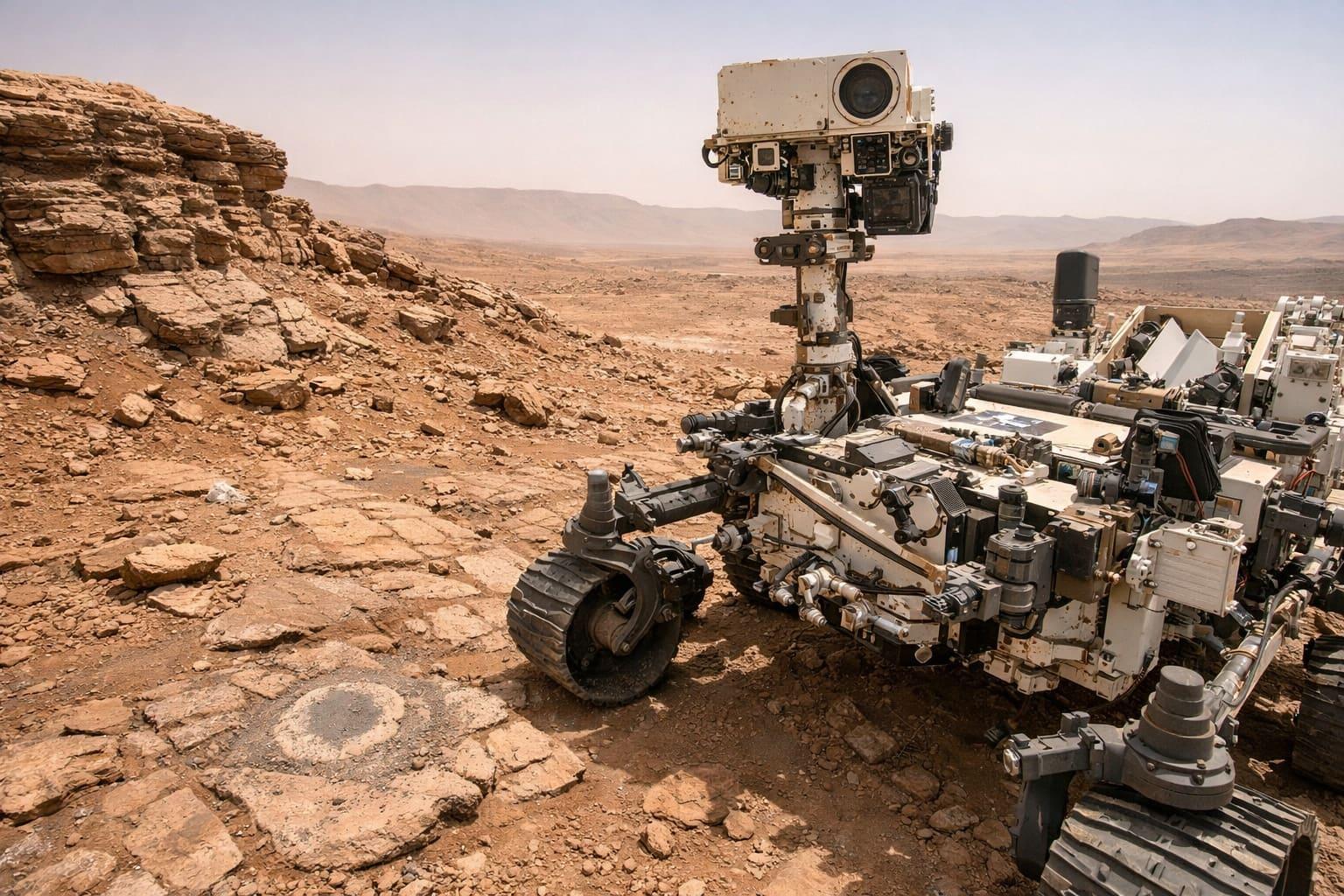
NASA’s Perseverance Rover Snaps Selfie in Mars’ Western Frontier
NASA's Perseverance rover has captured a stunning selfie at a location called 'Lac de Charmes' on Mars, showcasing ancient terrain. This image, composed of 61 individual photos, highlights the rover's ongoing exploration of the Martian surface, particularly its fifth science campaign. The selfie marks a significant milestone as the rover approaches marathon distance traveled on Mars.
The story
NASA's Perseverance rover recently captured a stunning self-portrait against the backdrop of ancient Martian terrain at a site known as 'Lac de Charmes.' This selfie, composed of 61 individual images, showcases the rover's position during its fifth science campaign, where it is exploring some of the most compelling geological features on Mars. The image was taken on March 11, 2026, during the rover's 1,797th Martian day, marking a significant moment in its mission as it pushes further west beyond Jezero Crater. The selfie highlights the rocky outcrop nicknamed 'Arethusa,' where Perseverance had just made a circular abrasion patch to analyze the rock's composition. The western rim of Jezero Crater stretches into the background, providing a dramatic setting for the rover's latest achievement. In addition to the selfie, Perseverance has been actively analyzing the geological features of the Lac de Charmes region. The rover's work includes studying the 'Arethusa' outcrop, which is composed of igneous minerals that predate the formation of Jezero Crater. This analysis is crucial as it could provide valuable insights into Mars' early crust and volcanic history. The rover's findings suggest that the Arethusa outcrop contains igneous rocks formed from molten rock that cooled underground, offering a glimpse into the planet's geological past. Perseverance has also captured an enhanced-color panorama of an area known as 'Arbot' on April 5, 2026, during its 1,882nd Martian day. This panorama, made of 46 images, reveals a windswept landscape with diverse rock textures, including features that may be megabreccia—large fragments created by a massive meteorite impact approximately 3.9 billion years ago. The rover's ongoing exploration includes plans to analyze other rocky outcrops in the Arbot area and eventually move to the 'Gardevarri' site, which is expected to yield further insights into Mars' volcanic history and geological processes.
Why it matters
The Perseverance rover's exploration is crucial for understanding Mars' geological history and potential habitability. By analyzing ancient rocks, scientists can gain insights into the planet's past conditions and processes. This knowledge is essential for future missions and the search for life beyond Earth. The findings from Perseverance's analyses could help answer fundamental questions about Mars' evolution, including whether it ever had conditions suitable for life. The rover's ability to capture detailed images and analyze rock samples enhances our understanding of the planet's history, which is vital for planning future exploration missions, including potential human landings on Mars. As scientists study the geological features and mineral compositions of the Martian surface, they are piecing together a narrative of the planet's past that could inform our understanding of planetary evolution in general.
Evidence and context
The Perseverance rover is part of NASA's broader Mars Exploration Program, which aims to uncover the planet's history and assess its potential for past life. This mission builds on the successes of previous rover missions, leveraging advanced technology to explore new terrains. As Perseverance continues its journey, it contributes to a growing body of knowledge that informs future exploration efforts, including potential human missions to Mars. The insights gained from this mission could have profound implications for our understanding of planetary evolution and the conditions necessary for life. The data collected by Perseverance will not only enhance our understanding of Mars but also provide valuable information for future missions, including the Mars Sample Return mission, which aims to bring Martian samples back to Earth for detailed analysis. This ongoing exploration is critical as it lays the groundwork for humanity's eventual goal of sending astronauts to Mars, making the findings from Perseverance's mission even more significant in the context of human space exploration.
Limits and unknowns
NASA's exploration of Mars has evolved significantly since the first successful landings in the 1970s. The Perseverance rover, launched in 2020, represents the latest advancement in this ongoing quest to understand the Red Planet. Previous missions, such as Spirit and Opportunity, focused on the search for signs of past life and the study of Martian geology. Perseverance builds on this legacy by employing advanced technology and scientific instruments to conduct in-depth analyses of the Martian surface. Its findings will contribute to a legacy of knowledge that informs future missions and our understanding of planetary science. The rover's exploration of ancient terrains, such as those found in Jezero Crater, is particularly significant as it seeks to uncover the history of water on Mars and the potential for past life, making it a pivotal part of NASA's Mars exploration narrative.
What happens next
As Perseverance continues its exploration, keep an eye on its upcoming analyses of the 'Gardevarri' site and 'Singing Canyon.' These areas are expected to yield significant geological insights that could further our understanding of Mars' volcanic history and crustal evolution. Additionally, watch for updates on the rover's sample collection efforts, which may provide crucial data for future Mars missions and the ongoing search for life. The results from these analyses could have far-reaching implications for our understanding of not only Mars but also the broader context of planetary science and the potential for life beyond Earth.
Follow the story
Share it, watch the explainer, or continue with the reporting trail.
Story timeline
Perseverance Launch
NASA launched the Perseverance rover to Mars as part of its Mars 2020 mission.
Perseverance Landing
The Perseverance rover successfully landed on Mars in the Jezero Crater.
First Selfie Taken
Perseverance captured its first selfie on Mars shortly after landing.
Current Selfie
Perseverance took a selfie at 'Lac de Charmes' during its fifth science campaign.
Further reading on this topic
3 links
NASA’s Perseverance Rover Snaps Selfie in Mars’ Western Frontier
A short visual explainer for readers who want the story in a different rhythm.