NASA Sends Mars Helicopter Blades Beyond Mach 1
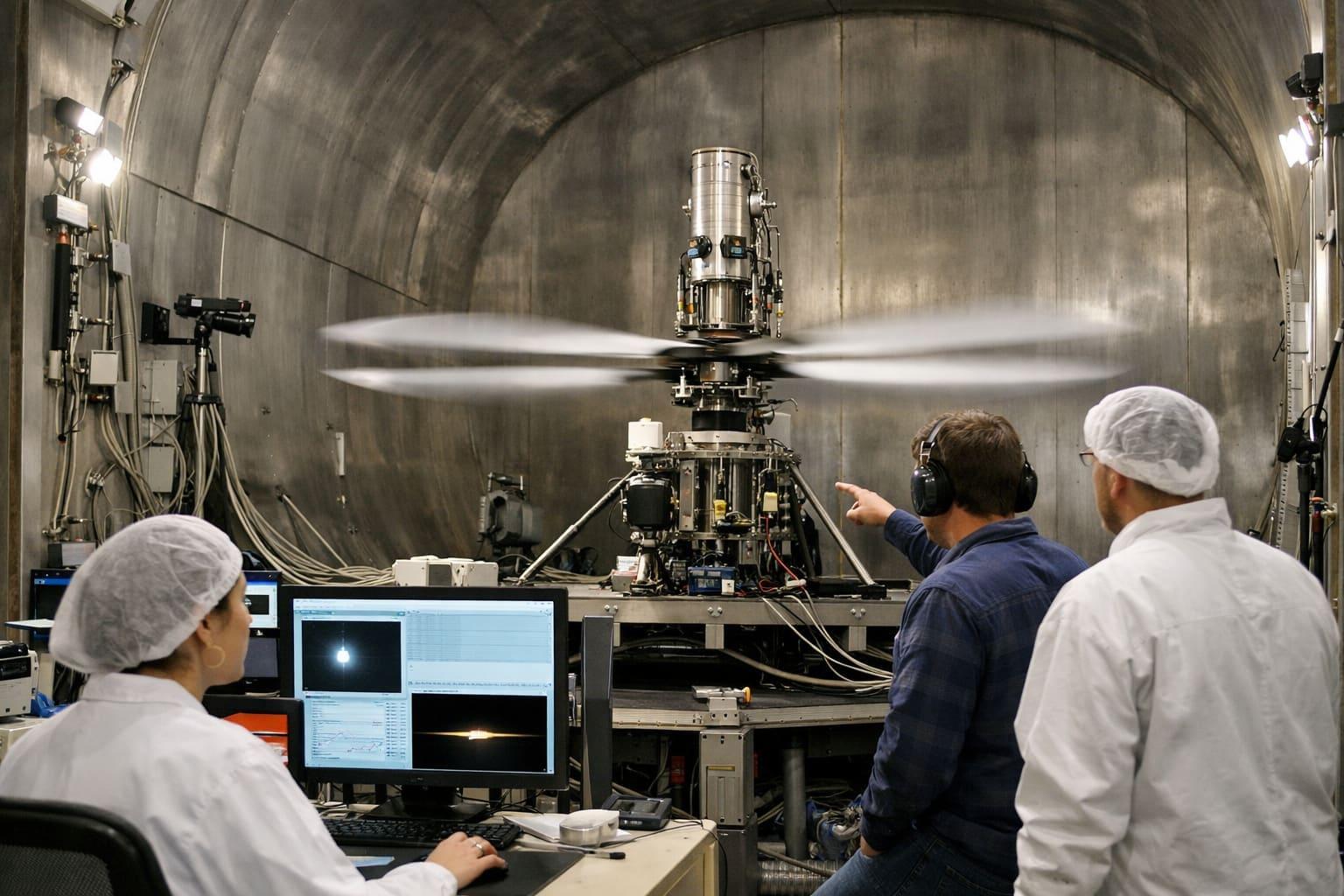
NASA has successfully tested next-generation rotor blades for Mars helicopters, achieving speeds exceeding Mach 1. This advancement is part of ongoing efforts to enhance aerial exploration capabilities on the Red Planet. The tests were conducted at the Jet Propulsion Laboratory, showcasing the potential for future Mars missions.
At a glance
Location and topic
Region
USA
Tag cluster
Trend count
+7 related briefs
What happened
NASA's Jet Propulsion Laboratory (JPL) has achieved a remarkable milestone in aerospace engineering by successfully testing next-generation rotor blades for Mars helicopters, surpassing speeds of Mach 1. This significant breakthrough was accomplished during a series of rigorous tests conducted within a 25-foot space simulator, specifically designed to replicate the thin atmosphere of Mars. The rotor blades, developed as part of NASA's Mars Exploration Program, are intended to enhance the capabilities of aerial vehicles for future missions to the Red Planet. The tests demonstrated that these advanced blades could withstand high speeds without structural failure, indicating their potential for use in more complex and efficient exploration of Mars's surface. This achievement not only showcases NASA's engineering prowess but also underscores the agency's commitment to pushing the boundaries of space exploration technology. The successful tests pave the way for the development of helicopters that can operate effectively in Mars's challenging environment, where the atmosphere is only about 1% as dense as Earth's. The implications of this technology are profound, as it could significantly improve the performance of aerial vehicles designed for Mars, allowing for more detailed and comprehensive scientific investigations. The rotor blades' ability to exceed the sound barrier without breaking apart is a testament to the innovative engineering and research efforts at JPL, which is managed by Caltech in Pasadena, California. This advancement is expected to play a crucial role in future Mars missions, enabling scientists to gather data from previously inaccessible areas and enhancing our understanding of the planet's geology and potential for past life.
Why this matters
The ability to exceed Mach 1 with rotor blades specifically designed for Mars represents a groundbreaking achievement that significantly enhances the potential for aerial exploration on the planet. This advancement opens the door to more sophisticated missions, allowing scientists to gather critical data from regions that were previously difficult or impossible to reach. As Mars exploration continues to evolve, such innovations are essential for deepening our understanding of the planet's geological history and its potential to have supported life in the past. The successful testing of these rotor blades not only demonstrates NASA's commitment to advancing technology but also highlights the importance of aerial vehicles in planetary exploration. With the capability to operate more efficiently in Mars's thin atmosphere, these helicopters could provide invaluable insights into the planet's surface features, climate, and potential resources. This achievement is a vital step toward realizing the full potential of aerial exploration on Mars, which could lead to groundbreaking discoveries in the field of planetary science.
What changed
The successful testing of rotor blades that can exceed Mach 1 marks a significant leap in aerospace technology, particularly for planetary exploration. This advancement allows for the deployment of more capable aerial vehicles on Mars, which can operate more efficiently in its thin atmosphere. The implications of this technology extend beyond Mars, potentially influencing future missions to other celestial bodies. The ability to gather data from previously inaccessible areas on Mars could lead to new scientific insights and a better understanding of the planet's history. This development also reflects a broader trend in aerospace engineering, where innovations are enabling more ambitious exploration missions. As NASA continues to refine its helicopter technology, the potential for discovering new scientific insights increases, making this achievement a pivotal moment in the ongoing exploration of Mars.
Bigger picture
The achievement of surpassing Mach 1 with Mars helicopter rotor blades is part of a broader trend in aerospace engineering, where advancements in technology are enabling increasingly ambitious exploration missions. As NASA continues to develop innovative solutions for Mars exploration, the potential for discovering new scientific insights grows. The success of these rotor blades could inspire further research and development in aerial technologies, not only for Mars but also for applications on Earth. The ongoing exploration of Mars is crucial for understanding the planet's history, climate, and potential for supporting life, making these advancements vital for future missions. The integration of advanced aerial vehicles into Mars exploration strategies could revolutionize how scientists study the planet, allowing for more dynamic and comprehensive investigations. This progress aligns with NASA's long-term goals of expanding human presence in space and enhancing our understanding of other worlds. As the agency prepares for future missions, the implications of this technology will likely extend to other planetary bodies, potentially transforming our approach to space exploration.
History
NASA's exploration of Mars has undergone significant evolution since the first successful landings in the 1970s. The agency has developed various technologies to study the planet, including rovers and orbiters, which have provided invaluable data about Mars's surface and atmosphere. The introduction of aerial vehicles, such as helicopters, marks a new chapter in Mars exploration, allowing for a more dynamic approach to studying the planet's surface. The development of rotor blades capable of exceeding Mach 1 is a culmination of years of research and innovation in aerospace engineering. This advancement reflects NASA's commitment to pushing the boundaries of what is possible in space exploration, as the agency seeks to enhance its capabilities for future missions. The successful testing of these rotor blades is a testament to the progress made in understanding and adapting technology for the unique challenges posed by Mars's environment, paving the way for more ambitious exploration efforts in the years to come.
Looking Towards the Future
As NASA continues to refine its Mars helicopter technology, future tests and missions will be critical to observe. The upcoming Mars missions may incorporate these advanced rotor blades, potentially leading to groundbreaking discoveries about the planet's geology and atmosphere. Keeping an eye on NASA's announcements regarding Mars exploration will provide insights into the next steps in this exciting field. Additionally, the integration of these technologies into future missions could significantly enhance our understanding of Mars and its potential for supporting life. Observers should also watch for collaborations between NASA and other space agencies, as advancements in aerial exploration could have implications for international efforts to explore Mars and beyond.
Story timeline
Mars Exploration Program Initiated
NASA launched the Mars Exploration Program to enhance understanding of the planet.
First Mars Helicopter Test
NASA's Ingenuity helicopter successfully flew on Mars, demonstrating aerial exploration capabilities.
Mach 1 Rotor Blade Tests
NASA tests next-generation rotor blades for Mars helicopters, achieving speeds beyond Mach 1.
Sources behind this brief
3 total
NASA
Original article detailing the rotor blade tests.
Phys.org
Coverage of the rotor blades exceeding Mach 1.
NASA
Additional details on the rotor blade tests.
Further reading on this topic
2 links
Context zone
USA
Context zone
USA
On this map
NASA Sends Mars Helicopter Blades Beyond Mach 1
USA
NASA Laser Terminal enhances views during Artemis II mission
United States
NASA's Artemis II mission showcased the effectiveness of laser communications, enabling high-definition data transfer between the Orion spacecraft and Earth. The optical terminal transmitted 484 gigabytes of data, significantly improving real-time science operations and public engagement. This advancement marks a pivotal step in enhancing future space missions.
NASA Fuel Cell Tests Pave Way for Energy Storage on the Moon
Cleveland, USA
NASA is advancing its lunar exploration efforts with the testing of regenerative fuel cell systems designed for energy storage on the moon. This innovative technology could significantly enhance power generation and storage capabilities for future missions, particularly under the Artemis program. The tests aim to validate the system's performance and readiness for deployment on the lunar surface.
Astronauts Experience Awe-Inspiring Solar Eclipse from Lunar Orbit
United States
During the Artemis II mission, astronauts witnessed a total solar eclipse from lunar orbit, marking a historic first. This unique perspective allowed them to see the moon completely obscuring the sun, with Earthshine illuminating the lunar surface. Such experiences can profoundly impact astronauts' perceptions of their place in the universe.
NASA’s Roman Poised to Transform Hunt for Elusive Neutron Stars
USA
NASA's upcoming Nancy Grace Roman Space Telescope is set to revolutionize the search for isolated neutron stars using astrometric microlensing. This innovative approach could allow astronomers to measure the mass of these elusive stellar remnants, which are typically difficult to detect. The telescope's capabilities may lead to significant advancements in our understanding of stellar evolution and the dynamics of the Milky Way.
AI Outperforms Doctors in Harvard Trial of Emergency Triage Diagnoses
Boston, United States
A recent Harvard study reveals that AI systems have surpassed human doctors in emergency triage diagnoses, particularly in high-pressure situations. The AI demonstrated a significant advantage in accuracy, diagnosing correctly in 67% of cases compared to 50-55% for human doctors. This breakthrough suggests a transformative shift in medical technology, potentially reshaping the role of healthcare professionals in emergency settings.
Good vibrations for quantum communications: Engineers couple single phonon to single atomic spin
Cambridge, United States
Researchers at Harvard have successfully coupled a single quantum of vibrational energy, or phonon, to a single atomic spin in diamond. This breakthrough paves the way for using sound as a medium for quantum information, potentially revolutionizing quantum technologies. The findings, published in Nature, highlight the promise of phonons as compact and long-lived carriers of quantum information.