Astronauts Experience Awe-Inspiring Solar Eclipse from Lunar Orbit
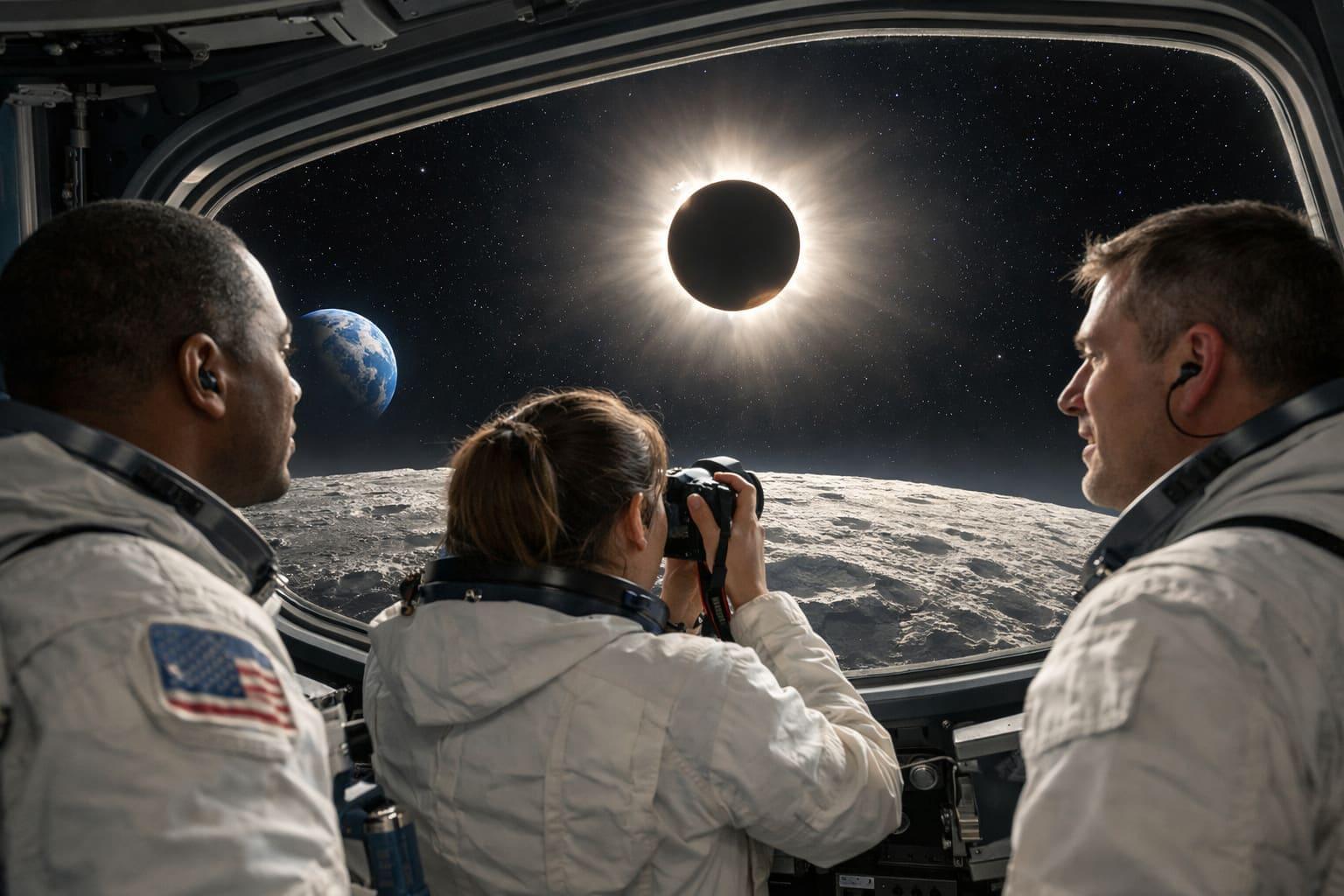
During the Artemis II mission, astronauts witnessed a total solar eclipse from lunar orbit, marking a historic first. This unique perspective allowed them to see the moon completely obscuring the sun, with Earthshine illuminating the lunar surface. Such experiences can profoundly impact astronauts' perceptions of their place in the universe.
At a glance
Location and topic
Region
United States
Tag cluster
Trend count
+13 related briefs
What happened
On April 6, 2026, astronauts aboard NASA's Artemis II mission became the first humans to observe a total solar eclipse from lunar orbit. This historic event unfolded as the spacecraft, traveling around the Moon, aligned perfectly with the Moon and the Sun, allowing the crew to witness the Sun's disk being completely obscured. From their unique vantage point, the astronauts were able to see the Sun's corona, a phenomenon typically invisible from Earth due to the Sun's brightness. The eclipse was further enhanced by the phenomenon known as Earthshine, where sunlight reflected off Earth illuminated the Moon's surface, revealing its craters and mountains in a soft twilight glow. Astronaut Victor Glover described the experience as feeling like they had 'just gone sci-fi,' capturing the surreal nature of the event. The eclipse lasted for an astonishing 54 minutes, during which the astronauts were captivated by the sight of the Sun hidden behind the Moon, surrounded by a hazy halo. This extraordinary event not only showcased the beauty of celestial mechanics but also evoked profound emotions among the crew. As they broadcasted live from their lunar flyby, their excitement and awe were palpable, demonstrating the powerful impact of such experiences on human perception and understanding of the universe. The Artemis II mission, part of NASA's broader Artemis program, aims to return humans to the Moon and establish a sustainable presence there, paving the way for future exploration of Mars and beyond. This eclipse experience marked a significant milestone in human space exploration, highlighting the potential for astronauts to witness celestial events in ways previously unimaginable.
Why this matters
Witnessing a solar eclipse from space offers a unique perspective that can alter astronauts' views on their role in the universe. The emotional and psychological effects of such awe-inspiring moments can lead to greater curiosity and a sense of responsibility towards Earth. Research has shown that experiences of awe can transform how individuals think and feel, making them more open-minded and thoughtful. For astronauts, these moments can deepen their understanding of the fragility of our planet and inspire them to advocate for its protection. The Artemis II mission's eclipse experience underscores the importance of space exploration in expanding human consciousness and fostering a deeper connection with our planet. As astronauts share their experiences with the public, they can inspire a new generation to appreciate the wonders of the universe and the need to care for our home. This mission not only represents a leap in technological achievement but also serves as a reminder of the profound impact that space exploration can have on human perception and societal values.
What changed
The Artemis II mission has set a new precedent for human space exploration, showcasing the potential for astronauts to experience celestial events in ways previously unimaginable. This event has sparked renewed interest in future missions and the possibilities they hold for scientific discovery and public engagement. The unique perspective gained from this eclipse may influence how astronauts approach their work and communicate their experiences to the public. As the first humans to witness a total solar eclipse from lunar orbit, the Artemis II crew's experience is likely to inspire future missions to prioritize similar opportunities for awe-inspiring encounters. This shift in focus could lead to a greater emphasis on the psychological and emotional aspects of space travel, encouraging astronauts to share their experiences in ways that resonate with audiences on Earth. The excitement generated by this event may also enhance public interest in space exploration, fostering a sense of connection between humanity and the cosmos. As NASA continues to develop its Artemis program, the lessons learned from the eclipse experience will likely shape the future of human spaceflight and exploration.
Bigger picture
The Artemis II mission is part of NASA's broader goal to establish a sustainable human presence on the Moon and eventually send humans to Mars. This solar eclipse experience highlights the potential for space exploration to inspire and educate, fostering a sense of wonder about the universe. As humanity continues to push the boundaries of space travel, such moments of awe can serve as powerful reminders of our place in the cosmos and the importance of protecting our home planet. The Artemis program aims to build on the legacy of the Apollo missions, which first landed humans on the Moon in 1969. By returning to the Moon, NASA hopes to conduct scientific research, test new technologies, and prepare for future missions to Mars. The unique perspective gained from witnessing a solar eclipse from lunar orbit not only enriches the astronauts' experiences but also contributes to our understanding of celestial phenomena. As we look to the future, the lessons learned from these missions will be crucial in addressing the challenges of long-duration space travel and the exploration of other planets. The excitement surrounding the Artemis II mission and its eclipse experience may also inspire international collaboration in space exploration, as countries come together to share knowledge and resources in pursuit of common goals in the cosmos.
History
Historically, solar eclipses have captivated human imagination and inspired scientific inquiry. Ancient civilizations often viewed eclipses as omens or messages from the gods, leading to a rich tapestry of myths and legends surrounding these celestial events. The ability to witness such an event from space adds a new chapter to this narrative, emphasizing the advancements in space exploration technology. The Artemis program represents a significant leap forward in human spaceflight, aiming to build on the legacy of the Apollo missions while paving the way for future exploration of Mars and beyond. The first total solar eclipse observed from space occurred during the Apollo 12 mission in 1966, but the Artemis II mission marks the first time humans have experienced a total solar eclipse from lunar orbit. This historical context underscores the importance of continued investment in space exploration and the potential for future discoveries that can reshape our understanding of the universe and our place within it.
Looking Towards the Future
As the Artemis program progresses, upcoming missions will likely continue to provide unique opportunities for astronauts to experience celestial events. Observers should look forward to the next total solar eclipse on August 12, 2026, which will be visible from parts of Greenland, Iceland, and Spain. This event will offer a chance for millions on Earth to witness the beauty of a total solar eclipse, while astronauts in future missions may have the opportunity to observe similar phenomena from space. The continued exploration of the Moon and Mars will also reveal new insights into our solar system and the universe. As NASA and other space agencies plan future missions, the lessons learned from the Artemis II eclipse experience will likely inform their strategies for maximizing the emotional and educational impact of space exploration.
Story timeline
Artemis II Mission Launch
NASA's Artemis II mission launched, marking a significant step in lunar exploration.
Total Solar Eclipse Observed
Astronauts aboard Artemis II witnessed a total solar eclipse from lunar orbit.
Next Total Solar Eclipse
A total solar eclipse will be visible from parts of Greenland, Iceland, and Spain.
Sources behind this brief
2 total
Phys.org
Original article detailing the eclipse experience from the Artemis II mission.
NASA
Official updates and information on the Artemis program.
Further reading on this topic
4 links
Context zone
United States
Context zone
United States
On this map
Astronauts Experience Awe-Inspiring Solar Eclipse from Lunar Orbit
United States
Good vibrations for quantum communications: Engineers couple single phonon to single atomic spin
Cambridge, United States
Researchers at Harvard have successfully coupled a single quantum of vibrational energy, or phonon, to a single atomic spin in diamond. This breakthrough paves the way for using sound as a medium for quantum information, potentially revolutionizing quantum technologies. The findings, published in Nature, highlight the promise of phonons as compact and long-lived carriers of quantum information.
Every dollar spent on forest fuel treatments saves $3.75 in wildfire damages, study finds
United States
A recent study from UC Davis reveals that investing in forest fuel treatments, such as thinning and prescribed burns, can save $3.75 for every dollar spent by preventing wildfire damages. The research analyzed nearly 300 wildfires across the western United States and found that these treatments significantly reduced wildfire spread and severity, preventing an estimated $2.8 billion in damages. The findings highlight the importance of investing in preventive forest management to mitigate the increasing risks of wildfires due to climate change.
Florida baby ‘born twice’ after elaborate surgery involving partial delivery
Orlando, United States
Cassian Joubert, a Florida infant, underwent a groundbreaking surgery that involved a partial delivery to save his life. This innovative procedure allowed doctors to create an airway for him while still in the womb, leading to his eventual birth. The Jouberts celebrate Cassian's unique journey with two birthdays, marking both his surgery and his birth.
Hundreds of animals rescued from ‘appalling’ conditions at California sanctuary
Julian, United States
Over 400 animals, including horses, cats, and dogs, were rescued from a California sanctuary facing bankruptcy and severe neglect. The San Diego Humane Society led the operation, uncovering widespread malnutrition and untreated injuries among the animals. This rescue highlights the ongoing challenges in animal welfare and the importance of vigilance in ensuring proper care.
US Supreme Court asked to restore abortion pill access
United States
Danco Laboratories has requested the US Supreme Court to intervene after a Fifth Circuit ruling reinstated in-person requirements for obtaining mifepristone, the abortion pill. This decision temporarily limits access to the medication, which has been available by mail since 2023. The case highlights ongoing tensions surrounding abortion access in the US, particularly in states with restrictive laws.
AI Outperforms Doctors in Harvard Trial of Emergency Triage Diagnoses
Boston, United States
A recent Harvard study reveals that AI systems have surpassed human doctors in emergency triage diagnoses, particularly in high-pressure situations. The AI demonstrated a significant advantage in accuracy, diagnosing correctly in 67% of cases compared to 50-55% for human doctors. This breakthrough suggests a transformative shift in medical technology, potentially reshaping the role of healthcare professionals in emergency settings.