Smart Probes Illuminate Proteins in Living Cells with Unprecedented Clarity
Researchers at Albert Einstein College of Medicine and the Salk Institute have developed a new imaging technology using engineered fluorescent nanobodies. This innovation allows for precise visualization of proteins inside living cells, significantly reducing background noise and enhancing clarity. The VIS-Fb probes can track multiple proteins simultaneously, providing insights into cellular processes and disease progression.
At a glance
Location and topic
Region
United States
Tag cluster
Trend count
+11 related briefs
What happened
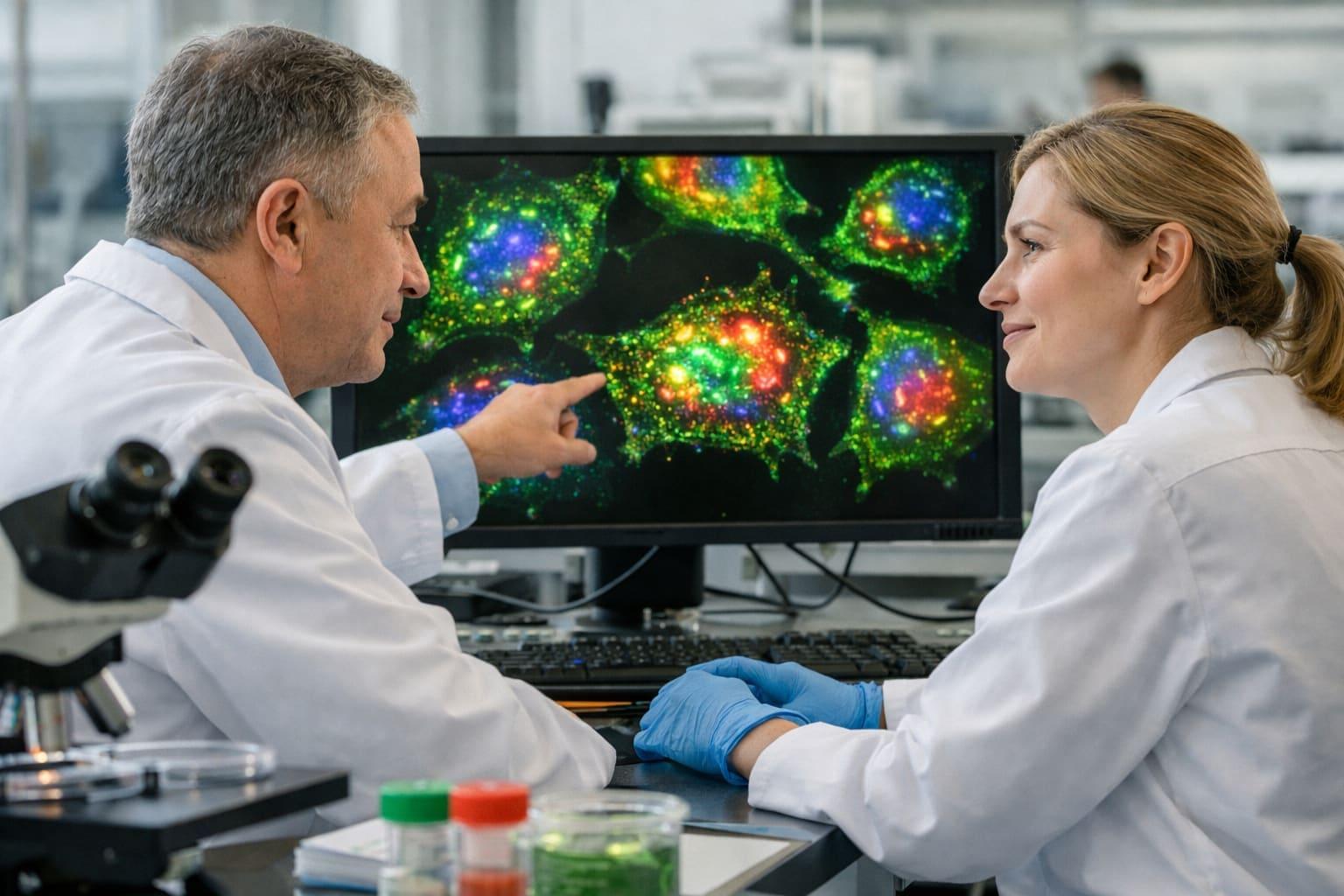
In a groundbreaking study published in *Nature Methods*, researchers from Albert Einstein College of Medicine and the Salk Institute for Biological Studies have unveiled a revolutionary imaging technology that significantly enhances the clarity of protein visualization within living cells and organisms. This new system employs engineered fluorescent nanobodies, known as VIS-Fbs (visible-spectrum target-stabilizable fluorescent nanobodies), which are designed to emit fluorescence only upon binding to their specific target proteins. This innovative approach addresses a critical limitation in traditional fluorescent imaging, where background signals often obscure the fine details of cellular processes. Vladislav Verkhusha, Ph.D., a co-corresponding author of the study, emphasized that the VIS-Fb probes eliminate the persistent background glow that has historically hindered the precision of intracellular imaging. The VIS-Fb probes are engineered to degrade rapidly if they do not bind to their intended targets, ensuring that fluorescence occurs only when the probes are correctly attached. This mechanism reduces background noise by up to 100-fold, allowing for much sharper and more accurate visualization of protein dynamics. The researchers developed VIS-Fb variants that fluoresce across a broad spectrum of colors, enabling simultaneous tracking of multiple proteins or cellular processes within the same living cell. This multicolor capability is particularly valuable for studying complex biological interactions. The team demonstrated the effectiveness of VIS-Fb probes in various living models, including mice and zebrafish embryos. In mice, the probes provided precise imaging of central nervous system activity, capturing neuronal and astrocytic dynamics during behavioral tasks. In zebrafish embryos, the technology facilitated real-time tracking of developmental changes and responses to pharmacological agents that alter signaling pathways. Overall, the VIS-Fb platform represents a significant advancement in molecular imaging, offering researchers a clearer and more detailed view of protein behavior in living systems, which could lead to new insights into cellular signaling, development, and disease progression.
Why this matters
The ability to visualize proteins with unprecedented clarity and specificity is crucial for advancing our understanding of cellular mechanisms and biological processes. The VIS-Fb technology represents a significant leap forward in imaging capabilities, which could have profound implications for various fields, including biology, medicine, and pharmacology. By enabling researchers to observe protein interactions and dynamics in real time, this technology could facilitate the identification of new therapeutic targets and the development of more effective treatments for diseases. For instance, in cancer research, understanding how tumor cells communicate and interact with their environment at the molecular level could lead to the discovery of novel strategies for intervention. Additionally, the enhanced imaging capabilities provided by VIS-Fb probes could improve diagnostic techniques, allowing for earlier detection of diseases and better monitoring of treatment responses. As researchers continue to explore the potential applications of this technology, it is likely to play a pivotal role in shaping the future of biomedical research and therapeutic development.
What changed
The introduction of VIS-Fb probes marks a transformative shift in the field of molecular imaging. Traditional fluorescent probes often emit background signals regardless of whether they are bound to their target proteins, leading to obscured details and reduced imaging precision. In contrast, VIS-Fb probes are designed to fluoresce only when they are attached to their specific targets, drastically reducing background noise and enhancing the clarity of protein visualization. This innovation allows researchers to achieve much sharper images of protein dynamics within living systems, enabling a more accurate understanding of cellular processes. Furthermore, the modular nature of the VIS-Fb platform allows for the creation of probes tailored to various experimental needs, making it a versatile tool for researchers. The ability to track multiple proteins simultaneously and to incorporate biosensors for ions and metabolites further enhances the utility of VIS-Fb probes, providing insights not only into where proteins are located but also into their functional activities in real time. This shift in imaging technology is expected to open new avenues for research and discovery in various biological fields.
Bigger picture
The development of VIS-Fb probes is part of a broader trend in scientific research aimed at enhancing imaging techniques to better understand complex biological systems. As researchers strive to unravel the intricacies of cellular processes, advancements like these are essential for pushing the boundaries of what is possible in biological imaging. The ability to visualize multiple proteins and their interactions in real time could lead to breakthroughs in various fields, including cancer research, neurobiology, and developmental biology. For instance, in cancer research, the VIS-Fb technology could enable scientists to observe how cancer cells communicate with their environment and how they respond to therapeutic interventions, potentially leading to more effective treatment strategies. In neurobiology, the ability to track neuronal signaling and interactions in real time could provide insights into the mechanisms underlying neurological disorders. Moreover, the VIS-Fb platform's capacity for ratiometric measurements enhances the accuracy of quantifying cellular processes, even in complex environments such as living brain tissue. This technology not only enhances our understanding of fundamental biological processes but also paves the way for innovative therapeutic strategies that could transform patient care. As the field of molecular imaging continues to evolve, the VIS-Fb probes represent a significant step forward in our quest to understand the molecular underpinnings of life.
History
Fluorescent imaging has been a cornerstone of biological research for decades, enabling scientists to visualize cellular components and processes with remarkable detail. The advent of fluorescent proteins in the 1990s revolutionized the field, allowing researchers to tag and track proteins in living cells. However, traditional fluorescent probes often suffered from limitations due to background noise, which obscured fine details and hindered the ability to observe dynamic processes. The evolution of nanobody technology has provided researchers with more precise tools for imaging, culminating in the recent development of VIS-Fb probes that address these challenges. By engineering probes that fluoresce only when bound to their target proteins, scientists have significantly improved the clarity and specificity of protein visualization. This advancement not only enhances our understanding of cellular mechanisms but also opens new avenues for research in areas such as drug development and disease modeling.
Looking Towards the Future
As the VIS-Fb technology continues to be refined, researchers will likely explore its applications in various fields, including cancer biology, neurobiology, and drug development. Observing how this technology influences research methodologies and therapeutic approaches will be crucial. In particular, the ability to visualize protein interactions in real time could lead to significant advancements in understanding disease mechanisms and developing targeted therapies. Additionally, advancements in modular probe design may lead to even more versatile imaging tools in the future, further enhancing our ability to study complex biological systems. Researchers will also be keen to investigate the long-term implications of this technology on our understanding of cellular processes and its potential to drive innovations in personalized medicine.
Story timeline
Development of VIS-Fb Probes
Researchers at Albert Einstein College of Medicine and Salk Institute unveil VIS-Fb probes for enhanced protein imaging.
Publication in Nature Methods
The findings are published in the journal Nature Methods, highlighting the significance of the new imaging technology.
Demonstration in Living Models
The VIS-Fb probes are successfully demonstrated in living models, showcasing their capabilities in real-time imaging.
Sources behind this brief
2 total
Phys.org
Original article on the development of VIS-Fb probes.
Nature Methods
Publication detailing the research findings.
Further reading on this topic
3 links
Albert Einstein College of Medicine
Official website of Albert Einstein College of Medicine, providing information on their research and publications.
Salk Institute for Biological Studies
Official website of the Salk Institute, detailing their scientific research and advancements.
PubMed Central
Database providing access to the full text of the study on VIS-Fb probes.
Context zone
United States
Context zone
United States
On this map
Smart Probes Illuminate Proteins in Living Cells with Unprecedented Clarity
United States
Hundreds of animals rescued from ‘appalling’ conditions at California sanctuary
Julian, United States
Over 400 animals, including horses, cats, and dogs, were rescued from a California sanctuary facing bankruptcy and severe neglect. The San Diego Humane Society led the operation, uncovering widespread malnutrition and untreated injuries among the animals. This rescue highlights the ongoing challenges in animal welfare and the importance of vigilance in ensuring proper care.
US Supreme Court asked to restore abortion pill access
United States
Danco Laboratories has requested the US Supreme Court to intervene after a Fifth Circuit ruling reinstated in-person requirements for obtaining mifepristone, the abortion pill. This decision temporarily limits access to the medication, which has been available by mail since 2023. The case highlights ongoing tensions surrounding abortion access in the US, particularly in states with restrictive laws.
NASA Laser Terminal enhances views during Artemis II mission
United States
NASA's Artemis II mission showcased the effectiveness of laser communications, enabling high-definition data transfer between the Orion spacecraft and Earth. The optical terminal transmitted 484 gigabytes of data, significantly improving real-time science operations and public engagement. This advancement marks a pivotal step in enhancing future space missions.
Astronauts Experience Awe-Inspiring Solar Eclipse from Lunar Orbit
United States
During the Artemis II mission, astronauts witnessed a total solar eclipse from lunar orbit, marking a historic first. This unique perspective allowed them to see the moon completely obscuring the sun, with Earthshine illuminating the lunar surface. Such experiences can profoundly impact astronauts' perceptions of their place in the universe.
AI Outperforms Doctors in Harvard Trial of Emergency Triage Diagnoses
Boston, United States
A recent Harvard study reveals that AI systems have surpassed human doctors in emergency triage diagnoses, particularly in high-pressure situations. The AI demonstrated a significant advantage in accuracy, diagnosing correctly in 67% of cases compared to 50-55% for human doctors. This breakthrough suggests a transformative shift in medical technology, potentially reshaping the role of healthcare professionals in emergency settings.
Rare two-colored lobster caught by fishermen off Cape Cod donated to aquarium
Falmouth, United States
A unique two-colored lobster, brown on one side and bright orange on the other, was caught off Cape Cod and donated to the Woods Hole Science Aquarium. This rare specimen will be displayed to the public when the aquarium reopens, highlighting the fascinating genetic anomalies in marine life. The donation reflects a commitment to conservation and education about marine biodiversity.