Blue Origin reuses New Glenn booster for the first time in Florida launch
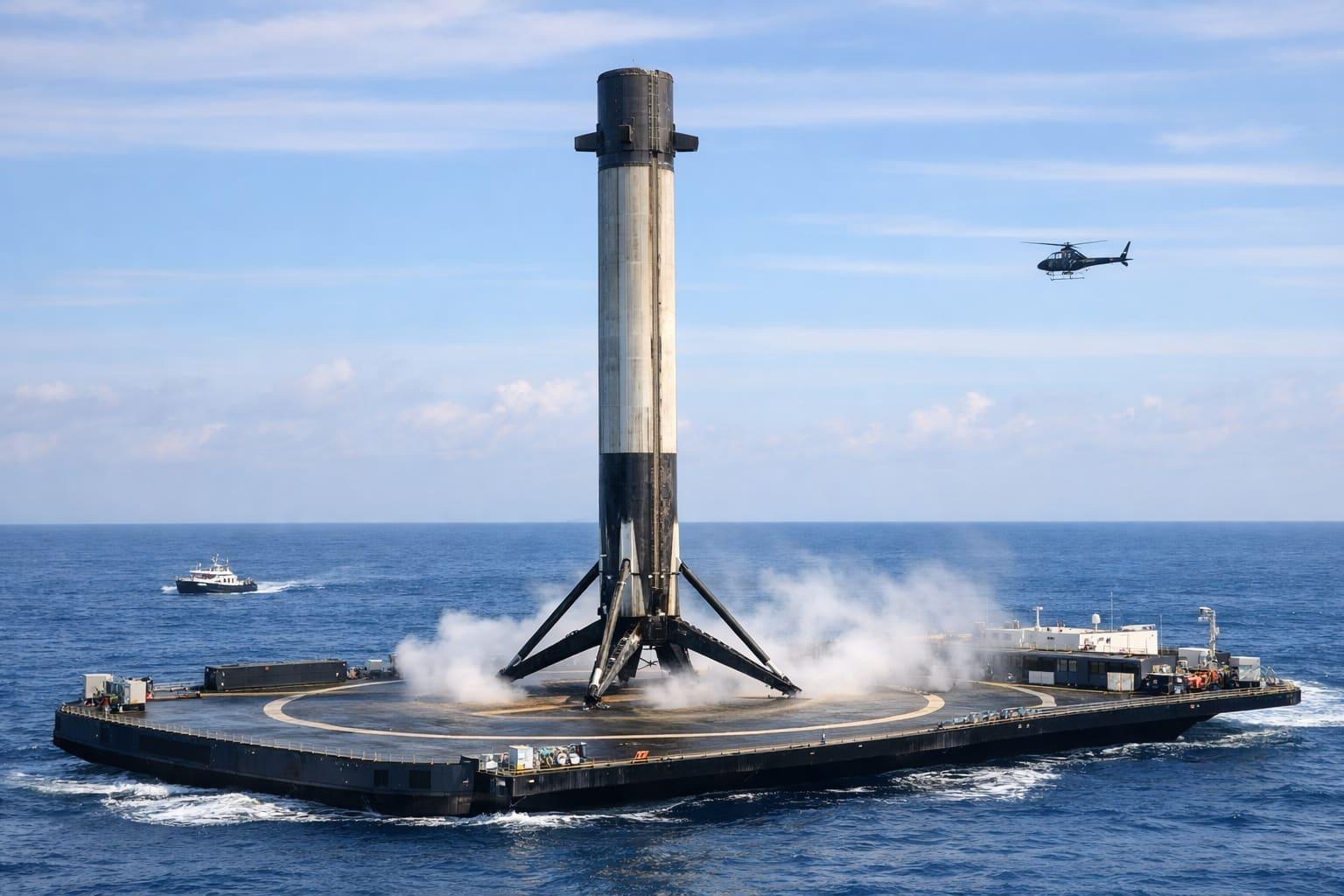
Blue Origin successfully reused a New Glenn rocket booster during a launch from Florida, marking a significant milestone in its space operations. This achievement demonstrates the company's capability to refurbish and recover rocket components, enhancing its competitiveness against SpaceX. The booster, which underwent extensive modifications, successfully landed on a floating platform after launching a communications satellite.
At a glance
Location and topic
Region
Cape Canaveral, United States
Tag cluster
Trend count
+7 related briefs
What happened
On April 12, 2026, Blue Origin achieved a significant milestone in space exploration by successfully launching its New Glenn rocket from Cape Canaveral, Florida, utilizing a reused booster for the first time. The launch took place at approximately 7:25 a.m. local time, carrying a communications satellite for AST SpaceMobile. This event marked a pivotal moment for Blue Origin, as it had previously launched the New Glenn only with new boosters. The New Glenn rocket, which stands at an impressive 98 meters (321 feet) tall, is designed for heavy payloads and is central to Blue Origin's ambitions in the commercial space sector. After liftoff, the rocket's two stages separated as planned, with the upper stage continuing its journey to deploy the satellite into orbit. Meanwhile, the booster successfully landed on a floating platform in the Atlantic Ocean about nine minutes and thirty seconds post-launch, demonstrating Blue Origin's capability to recover and reuse rocket components. This successful recovery follows a previous attempt in January 2025, which ended in failure when the booster’s engines failed to reignite during descent. For this launch, the booster underwent extensive refurbishment, including the replacement of all its engines and several modifications to ensure its readiness for reuse. This achievement not only showcases Blue Origin's technical prowess but also positions the company to increase its launch frequency and enhance its competitiveness against SpaceX, which has already established a track record of successful booster recoveries.
Why this matters
The successful reuse of the New Glenn booster is a transformative development in the aerospace industry, as it has the potential to drastically reduce the costs associated with space launches. By demonstrating the ability to refurbish and reuse rocket components, Blue Origin is positioning itself as a formidable competitor in the commercial space market. This achievement enhances the company's operational capabilities and contributes to the sustainability of space exploration efforts. The implications of this success extend beyond Blue Origin; it sets a precedent for the industry, encouraging other companies to invest in reusable technology. As the cost of access to space decreases, it opens up new opportunities for scientific research, satellite deployment, and even future manned missions to the Moon and Mars. The ability to reuse rocket boosters could lead to a new era of space exploration, where missions are more frequent and economically viable, ultimately benefiting humanity's quest to explore beyond our planet.
What changed
The successful reuse of the New Glenn booster signifies a strategic shift in Blue Origin's operational model, emphasizing sustainability and cost-effectiveness in space launches. This achievement is likely to instill greater confidence among clients and stakeholders in Blue Origin's capabilities, potentially attracting more business opportunities and partnerships. The successful refurbishment and recovery of the booster not only enhances Blue Origin's reputation but also sets a new standard for future missions, encouraging other aerospace companies to invest in similar reusable technologies. As the industry moves towards a more sustainable model, this milestone could lead to increased collaboration among companies and government agencies, fostering innovation and advancements in space technology. Furthermore, the successful reuse of the booster may influence pricing strategies in the commercial launch market, as companies seek to offer competitive rates while maintaining profitability. This shift could reshape the landscape of space exploration, making it more accessible to a broader range of clients, including startups and international organizations.
Bigger picture
The successful reuse of the New Glenn booster is part of a broader trend in the aerospace industry towards sustainability and cost reduction through reusable technology. As companies like Blue Origin and SpaceX continue to innovate, the landscape of space exploration is evolving, with a focus on making access to space more affordable and efficient. This shift is crucial as governments and private entities aim to expand their presence in space, including ambitious plans for lunar missions and beyond. The advancements in reusable rocket technology not only benefit commercial interests but also support scientific research and exploration initiatives. The competition between Blue Origin and SpaceX is particularly noteworthy, as both companies strive to lead in the commercial space sector. SpaceX has already established a strong foothold with its Falcon 9 and Falcon Heavy rockets, which have successfully demonstrated booster recovery multiple times. Blue Origin's recent success with the New Glenn booster could catalyze further advancements in the industry, prompting other companies to accelerate their own reusable technology development. As the space race intensifies, the implications of these advancements extend beyond commercial interests; they could play a pivotal role in future human exploration of the Moon and Mars, as well as the establishment of sustainable practices in space travel. The ongoing developments in reusable rocket technology are not just about reducing costs; they represent a fundamental shift in how humanity approaches space exploration, with the potential to unlock new frontiers and opportunities for generations to come.
History
The concept of reusable rockets has been a goal in the aerospace industry for decades, with early attempts dating back to the 1980s. However, significant progress in this area was not realized until the emergence of private companies like SpaceX, which revolutionized the industry with its Falcon 9 rocket. Founded by Elon Musk in 2002, SpaceX successfully demonstrated the feasibility of reusing rocket boosters, significantly reducing launch costs and changing the dynamics of space access. Blue Origin, established by Jeff Bezos in 2000, has been working on its own reusable rocket technology, focusing on the New Shepard and New Glenn rockets. The successful reuse of the New Glenn booster represents a culmination of years of research and development in this field, showcasing Blue Origin's commitment to innovation and competition in the rapidly evolving space market. This achievement not only highlights the technical capabilities of Blue Origin but also reflects a broader trend in the aerospace industry towards sustainability and efficiency, as companies strive to make space exploration more accessible and economically viable.
Looking Towards the Future
As Blue Origin continues to develop its New Glenn rocket and refine its booster reuse capabilities, observers should keep an eye on upcoming launches and any announcements regarding new contracts or partnerships. The competitive landscape between Blue Origin and SpaceX will be crucial to monitor, as both companies strive to lead in the commercial space sector. Future missions may reveal further advancements in reusable technology and its implications for the industry. Additionally, the response from government agencies, particularly NASA, will be significant as they evaluate the capabilities of both companies for future lunar and Mars missions. The ongoing developments in reusable rocket technology could also influence international space policies and collaborations, shaping the future of space exploration on a global scale.
Story timeline
New Glenn Launch
Blue Origin successfully launches the New Glenn rocket with a reused booster from Cape Canaveral.
Previous Booster Recovery Attempt
An earlier attempt to recover a New Glenn booster fails due to engine issues during descent.
First Successful Booster Recovery
Blue Origin successfully recovers a New Glenn booster for the first time, marking a significant technical achievement.
Sources behind this brief
2 total
Phys.org
Original article detailing the launch and booster reuse.
Spaceflight News API
Corroborating source providing additional context on the New Glenn launch.
Further reading on this topic
2 links
Context zone
United States
Context zone
United States
On this map
Blue Origin reuses New Glenn booster for the first time in Florida launch
Cape Canaveral, United States
Astronauts Experience Awe-Inspiring Solar Eclipse from Lunar Orbit
United States
During the Artemis II mission, astronauts witnessed a total solar eclipse from lunar orbit, marking a historic first. This unique perspective allowed them to see the moon completely obscuring the sun, with Earthshine illuminating the lunar surface. Such experiences can profoundly impact astronauts' perceptions of their place in the universe.
AI Outperforms Doctors in Harvard Trial of Emergency Triage Diagnoses
Boston, United States
A recent Harvard study reveals that AI systems have surpassed human doctors in emergency triage diagnoses, particularly in high-pressure situations. The AI demonstrated a significant advantage in accuracy, diagnosing correctly in 67% of cases compared to 50-55% for human doctors. This breakthrough suggests a transformative shift in medical technology, potentially reshaping the role of healthcare professionals in emergency settings.
New genome editing method could swap entire genes and correct 1000 mutations at once
United States
A groundbreaking genome editing technique allows for the insertion of large DNA segments, potentially correcting up to 1,000 mutations simultaneously. This method, termed 'prime assembly,' utilizes overlapping DNA flaps to avoid double-strand breaks, enhancing gene therapy applications. Researchers believe this innovation could revolutionize treatments for genetic disorders by enabling comprehensive gene replacements.
Rare two-colored lobster caught by fishermen off Cape Cod donated to aquarium
Falmouth, United States
A unique two-colored lobster, brown on one side and bright orange on the other, was caught off Cape Cod and donated to the Woods Hole Science Aquarium. This rare specimen will be displayed to the public when the aquarium reopens, highlighting the fascinating genetic anomalies in marine life. The donation reflects a commitment to conservation and education about marine biodiversity.
NASA’s Perseverance, Curiosity Panoramas Capture Two Sides of Mars
United States
NASA's Curiosity and Perseverance rovers have unveiled stunning 360-degree panoramas of Mars, showcasing the planet's diverse geological history. Curiosity explores younger terrains while Perseverance investigates some of the oldest landscapes, revealing insights into Mars' past and potential for life. These images highlight the rovers' contributions to understanding the Red Planet's formation and ancient environments.
World leaders react to White House press dinner shooting: no place for violence in democracy
Washington, United States
Following a shooting incident at the White House Correspondents' Dinner, global leaders condemned the violence and emphasized the importance of safety in democratic events. Many praised the quick response of security forces, highlighting the need for vigilance in protecting public gatherings. The incident has sparked discussions about security measures at such high-profile events.