DESI Completes Largest 3D Map of the Universe
The Dark Energy Spectroscopic Instrument (DESI) has successfully completed the largest high-resolution 3D map of the universe, capturing data from over 47 million galaxies and quasars. This achievement allows researchers to investigate dark energy's role in cosmic expansion, with early results suggesting it may evolve over time. The project, involving over 900 researchers globally, will continue to analyze the data and expand the survey to refine measurements of dark energy and the universe's structure.
At a glance
Location and topic
Region
USA
Tag cluster
Trend count
+8 related briefs
What happened
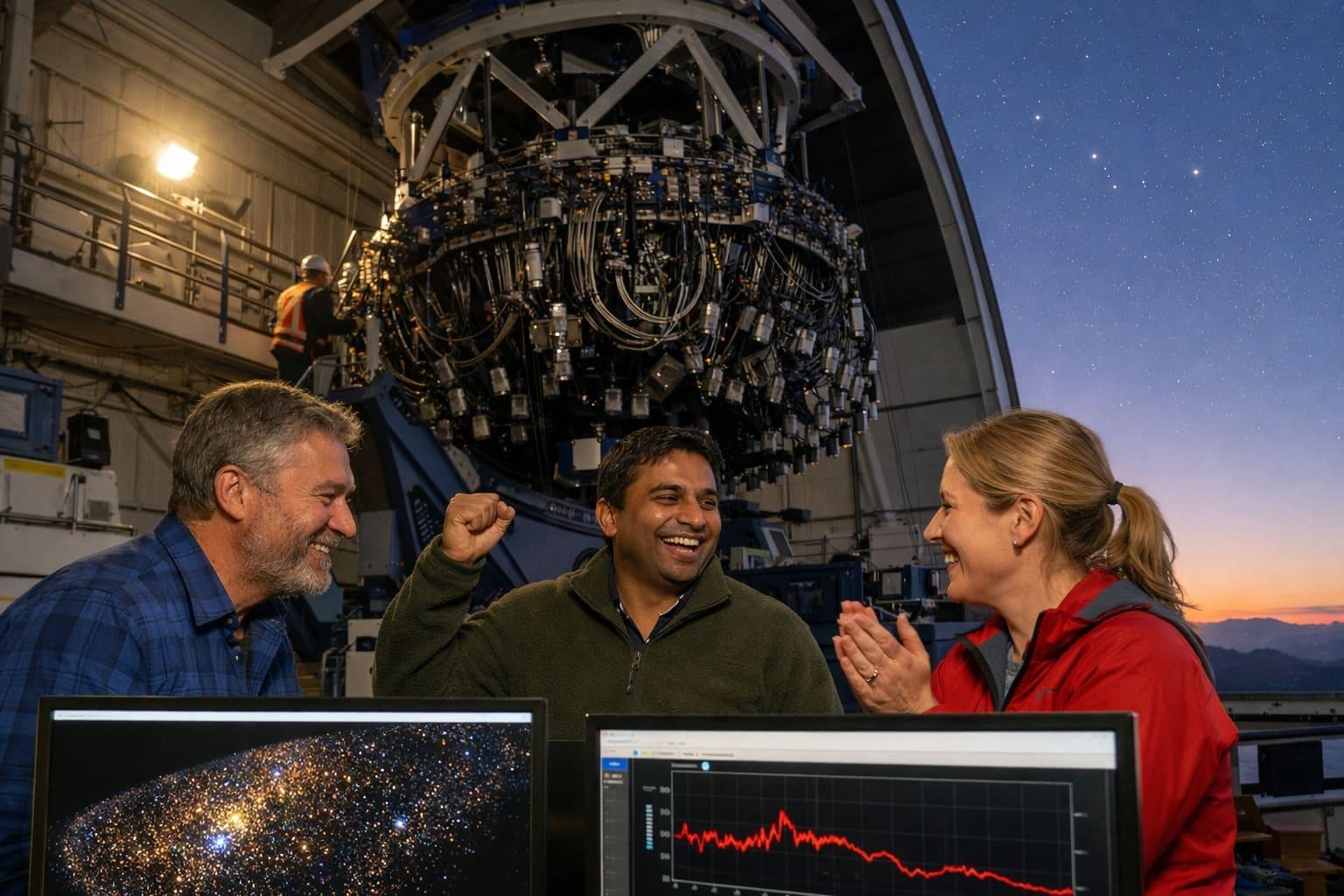
The Dark Energy Spectroscopic Instrument (DESI) has successfully completed its five-year survey, culminating in the creation of the largest high-resolution 3D map of the universe to date. This monumental achievement was made possible through the collaborative efforts of over 900 researchers from more than 70 institutions worldwide, including prominent organizations such as the University of Portsmouth, University College London, and Durham University, alongside the Lawrence Berkeley National Laboratory in California. The final observations were conducted in a targeted region of the sky near the Little Dipper, marking a significant milestone in the quest to understand cosmic expansion driven by dark energy. DESI's advanced technology, featuring 5,000 fiber-optic sensors, allowed it to capture data from over 47 million galaxies and quasars, far surpassing its initial goal of 34 million. This extensive dataset enables researchers to investigate dark energy, which constitutes approximately 70% of the universe and is responsible for its accelerating expansion. Early findings from the first three years of data suggested that dark energy might not be a constant force, as previously thought, but could evolve over time. With the completion of the full five-year dataset, scientists are now equipped to further explore this hypothesis and refine their measurements of dark energy's influence over an impressive 11 billion years of cosmic history. Dr. Seshadri Nadathur, an Associate Professor at the University of Portsmouth, emphasized the importance of this map for cosmology, stating that the potential evolution of dark energy would be revolutionary. The DESI collaboration is now poised to analyze the data and uncover new insights into the universe's structure and the fundamental forces that govern it.
Why this matters
Understanding dark energy is crucial for cosmology, as it plays a significant role in the universe's expansion and ultimate fate. The insights gained from DESI's extensive dataset could lead to revolutionary changes in our comprehension of fundamental cosmic forces. If dark energy is found to evolve over time, it would challenge the long-held belief that it is a constant, fundamentally altering our understanding of the universe's dynamics. This could have profound implications for theories regarding the universe's ultimate fate, including scenarios of continued expansion or potential collapse. As researchers delve into the data, they may uncover new phenomena that challenge existing theories and enhance our grasp of the universe. The collaboration of over 900 researchers from diverse institutions underscores the importance of collective scientific inquiry in tackling complex questions about the cosmos. The findings from DESI will not only contribute to our understanding of dark energy but may also influence related fields such as particle physics and the study of fundamental forces, making this research pivotal for the future of cosmology.
What changed
The completion of DESI's survey marks a significant advancement in astronomical research, providing a dataset six times larger than all previous surveys combined. This expansion allows for a more detailed understanding of the universe's structure and the role of dark energy. The project has exceeded its original goals, capturing light from a vast array of galaxies and quasars, and is now set to push beyond its initial mission. The survey will expand its reach into new and more challenging regions of the sky, including areas closer to the crowded plane of the Milky Way, where bright nearby stars can obscure distant galaxies. This ongoing expansion will enhance the density and detail of the cosmic map, allowing researchers to observe a new class of fainter, more distant luminous red galaxies. The project will continue to evolve as researchers process the data and explore new areas of the sky, pushing the boundaries of our cosmic knowledge. The first dark energy results from DESI's full five-year survey are expected in 2027, promising to refine our understanding of dark energy and its implications for the universe's structure and evolution.
Bigger picture
The DESI project is part of a broader effort in cosmology to understand the fundamental forces shaping our universe. Dark energy remains one of the most enigmatic components of cosmology, and the insights gained from DESI's extensive dataset could lead to groundbreaking discoveries. The collaboration among over 900 researchers highlights the global nature of scientific inquiry, emphasizing the importance of collective efforts in tackling complex questions about the universe. As researchers analyze the data, they may uncover new phenomena that challenge existing theories and enhance our grasp of the universe. The implications of DESI's findings extend beyond cosmology, potentially influencing related fields such as particle physics and the study of fundamental forces. The ongoing expansion of the survey will allow for continuous data collection and refinement of measurements, further enhancing our understanding of the universe's evolution. As the scientific community eagerly anticipates the first results from the complete five-year survey, the potential for new discoveries looms large, promising to reshape our understanding of the cosmos and our place within it. The future of cosmological research is bright, with DESI at the forefront of this exciting exploration.
Looking Towards the Future
As researchers begin to analyze the full dataset from DESI, expect new studies and findings related to dark energy and the structure of the universe. The first results from the complete five-year survey are anticipated in 2027, which may provide further insights into the nature of dark energy and its implications for cosmology. Additionally, the ongoing expansion of the survey will continue to enhance our understanding of the universe's evolution. Researchers will be particularly focused on how the new data can refine measurements of dark energy and explore its potential evolution over time. The scientific community is poised for a series of exciting revelations that could redefine our understanding of the universe and its fundamental forces.
Story timeline
DESI Begins Data Collection
DESI starts capturing data from galaxies and quasars.
Completion of Survey
DESI completes its five-year survey, producing a comprehensive 3D map of the universe.
First Results Expected
Initial findings from the complete dataset are anticipated to be released.
Sources behind this brief
2 total
Phys.org
Original article detailing DESI's completion of the 3D map.
University of Portsmouth
Institution involved in the DESI project.
Further reading on this topic
3 links
Carnegie Mellon University
Details on DESI's completion of its 3D universe map and future exploration plans.
University of California, Santa Cruz
Information on DESI's 3D map and its role in studying dark energy.
Lawrence Berkeley National Laboratory
Insights into DESI's 3D map and ongoing research into dark energy.
Context zone
USA
Context zone
USA
On this map
DESI Completes Largest 3D Map of the Universe
USA
Volunteers Discover Rare Space Weather Events Using Their Ears
USA
NASA's HARP project has engaged volunteers to listen to space weather phenomena, leading to unexpected discoveries about plasma waves. Participants translated magnetic field data into sound, revealing anomalies in wave patterns that challenge previous scientific expectations. This citizen science initiative not only enhances understanding of space weather but also inspires participants to pursue scientific careers.
Roman Space Telescope Launching in September
USA
NASA has announced that the Nancy Grace Roman Space Telescope is set to launch in September 2026, ahead of schedule and under budget. This telescope will complement the James Webb Space Telescope by surveying the universe broadly, identifying targets for more detailed examination. Named after NASA's first Chief of Astronomy, Nancy Grace Roman, the telescope aims to uncover new insights about the universe, including the nature of dark energy and the expansion of the cosmos.
NASA’s Hubble Dazzles With Young Stars in Trifid Nebula
USA
NASA celebrates the 36th anniversary of the Hubble Space Telescope with a stunning new image of the Trifid Nebula, showcasing its vibrant star-forming region. The telescope's advanced capabilities allow for detailed observations of changes in the nebula over time, revealing the dynamic processes of star formation. This latest image highlights the impact of massive stars on their surroundings, triggering new waves of star birth.
Astronauts Experience Awe-Inspiring Solar Eclipse from Lunar Orbit
United States
During the Artemis II mission, astronauts witnessed a total solar eclipse from lunar orbit, marking a historic first. This unique perspective allowed them to see the moon completely obscuring the sun, with Earthshine illuminating the lunar surface. Such experiences can profoundly impact astronauts' perceptions of their place in the universe.
Protein-Engineering Breakthrough Generates Over 10M Data Points in Three Days
United States
Researchers at Rice University have developed a method called Sequence Display that generates over 10 million data points for protein activity in just three days. This breakthrough enables the training of AI models to optimize protein functions, addressing a significant bottleneck in AI-guided protein engineering. The approach combines activity-based barcoding with next-generation sequencing, allowing for efficient identification of beneficial mutations in proteins.