Two blazing quasars caught waltzing into a merger
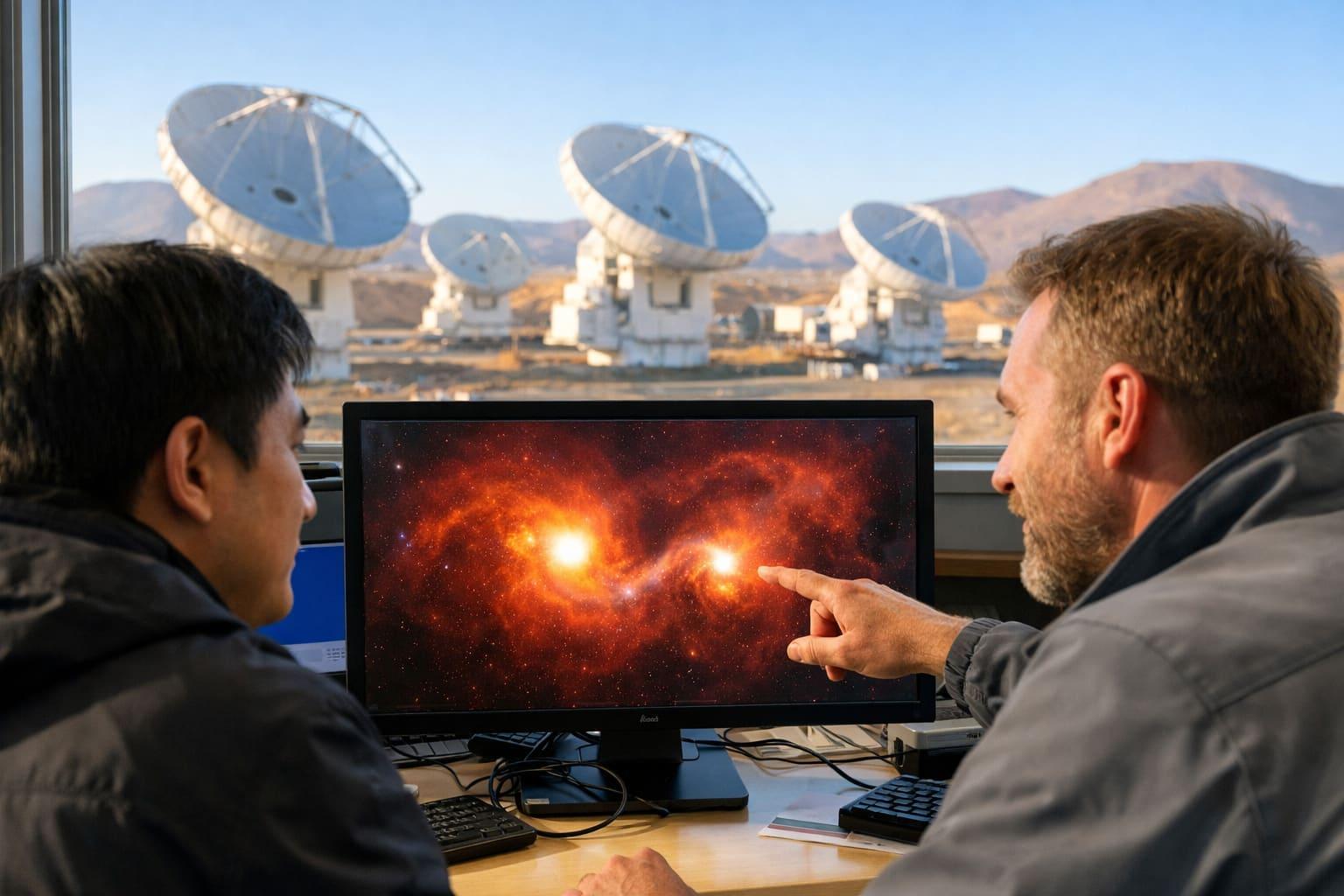
Astronomers have confirmed a rare quasar pair, J2037–4537, in merging galaxies at redshift 5.7, using ALMA observations. This discovery, one of only two such pairs found at this distance, reveals insights into galaxy mergers and supermassive black hole activity. The study indicates that these quasars are likely to evolve into a binary system over billions of years, contributing to our understanding of gravitational waves.
At a glance
Location and topic
Region
Global
Tag cluster
Trend count
+4 related briefs
What happened
Astronomers utilizing the Atacama Large Millimeter/submillimeter Array (ALMA) have confirmed the existence of a close quasar pair, designated J2037–4537, located within merging galaxies at a redshift of 5.7. This discovery is particularly significant as it represents one of only two confirmed quasar pairs at redshift greater than 5, providing valuable insights into the early universe, which was less than a billion years old at that time. The findings were detailed in a paper submitted to the preprint server arXiv on April 7, 2026. Quasars are among the most luminous objects in the universe, powered by supermassive black holes situated at the centers of galaxies. These black holes do not remain in an active state continuously; rather, they are triggered into activity by various mechanisms, one of which is believed to be galaxy mergers. When galaxies collide over millions of years, their gas is funneled toward the center, feeding the black holes and igniting them as quasars. The research team, led by Minghao Yue from the University of Arizona, conducted high-resolution observations to confirm the nature of J2037–4537, effectively ruling out alternative explanations such as gravitational lensing, which could suggest that the two objects were merely separate images of a single quasar. By mapping the [CII] (ionized carbon) emission lines—tracers of cold, star-forming gas—the team discovered that this emission extended between the two quasars, indicating a tidal bridge formed as a result of their merger. This finding decisively ruled out the gravitational lensing scenario, confirming J2037–4537 as a genuine quasar pair. The two quasar-host galaxies are massive, each with a dynamical mass of at least 10 billion solar masses and a star formation rate exceeding 500 solar masses per year. Currently, the two supermassive black holes are separated by thousands of light-years and are not yet a binary system, but the study estimates that it will take approximately 2.1 billion years for J2037–4537 to transition into a gravitationally bound binary supermassive black hole system. This transition is expected to occur around a redshift of 2, and the eventual merger of these quasars could emit low-frequency gravitational waves detectable by Pulsar Timing Arrays (PTAs). This is particularly intriguing as recent PTA experiments have detected a gravitational wave background stronger than predicted by galaxy evolution models, suggesting that systems like J2037–4537 could help explain this excess.
Why this matters
The discovery of J2037–4537 is crucial for understanding the dynamics of early galaxy formation and the conditions that lead to the activation of supermassive black holes. This research sheds light on the processes that govern galaxy mergers and their role in quasar activity, which is fundamental to astrophysics. By confirming the existence of a quasar pair in such an early stage of the universe, scientists can better comprehend how galaxies evolve and interact over cosmic time. Furthermore, the implications of this study extend to future research on gravitational waves emitted during quasar mergers, which could provide new insights into the nature of these cosmic phenomena. Understanding the relationship between quasar activity and galaxy evolution is essential for piecing together the history of the universe and the formation of its large-scale structures.
What changed
The confirmation of J2037–4537 as a genuine quasar pair marks a significant advancement in our understanding of quasar formation and the role of galaxy mergers in the early universe. This finding challenges previous assumptions regarding the rarity of such systems, particularly at high redshifts. The study's results provide a clearer picture of the relationship between quasar activity and galaxy evolution, suggesting that the conditions leading to the simultaneous presence of two quasars in a single merging system may be more common than previously thought. This research not only enhances our knowledge of quasar dynamics but also opens new avenues for exploring the evolution of supermassive black holes and their impact on galaxy formation. The implications of this study could reshape our understanding of the early universe and the processes that shaped it.
Bigger picture
The discovery of J2037–4537 fits into the broader context of understanding the universe's evolution, particularly during its formative years. As astronomers continue to explore the early universe, findings like this one help to piece together the complex interactions between galaxies and their central black holes. The potential for these quasars to evolve into a binary system raises important questions about the future of gravitational wave astronomy. Such mergers could contribute to the gravitational wave background detected by Pulsar Timing Arrays, which have recently observed a stronger-than-expected gravitational wave background. This suggests that the universe may be more dynamic than previously understood, with more quasar pairs and mergers occurring than current models predict. The implications of this research extend beyond individual quasar pairs, as it may inform our understanding of galaxy formation and evolution on a cosmic scale. As technology advances, future observations of similar systems will be crucial in refining our models of the universe's history and the processes that govern its evolution.
History
The study of quasars has evolved significantly since their discovery in the 1960s, initially thought to be stars due to their immense brightness. As technology advanced, it became clear that quasars are powered by supermassive black holes at the centers of galaxies. The understanding of their formation, particularly in relation to galaxy mergers, has been a key focus in astrophysics. Early research suggested that quasars were rare, but as observational techniques improved, astronomers began to uncover more about their prevalence and the conditions that lead to their activation. The confirmation of quasar pairs like J2037–4537 represents a significant milestone in this ongoing research, providing insights into the early universe and the processes that shaped it. This historical perspective highlights the importance of continued exploration and observation in unraveling the complexities of cosmic evolution.
Looking Towards the Future
Future observations of J2037–4537 and similar quasar pairs will be crucial in understanding the dynamics of galaxy mergers and the formation of supermassive black holes. Researchers will likely focus on the star formation rates and the eventual evolution of these systems into binary black holes. Additionally, advancements in gravitational wave detection technology may provide new insights into the cosmic events associated with quasar mergers. As more quasar pairs are discovered, they could help refine our models of galaxy evolution and the role of supermassive black holes in shaping the universe.
Story timeline
Discovery of J2037–4537
A paper was submitted to arXiv detailing the findings of the quasar pair.
ALMA Observations
Astronomers confirmed the existence of the quasar pair using ALMA technology.
Future Binary Formation
Estimates suggest J2037–4537 will evolve into a binary supermassive black hole system.
Sources behind this brief
2 total
Phys.org
Original article detailing the discovery of the quasar pair.
arXiv
Preprint paper outlining the research findings.
Further reading on this topic
2 links
Context zone
Context zone
On this map
Two blazing quasars caught waltzing into a merger
Global
No other published articles from this region yet. This marker anchors the story for future regional clustering.