NASA’s Webb Redefines Dividing Line Between Planets, Stars
NASA's James Webb Space Telescope has provided new insights into the formation of massive celestial bodies, specifically 29 Cygni b, which weighs 15 times that of Jupiter. The findings suggest that this object formed through a process of accretion within a protoplanetary disk, rather than through gas fragmentation, challenging previous assumptions about the formation of such massive planets. This research enhances our understanding of planetary formation and the characteristics that distinguish planets from stars.
At a glance
Location and topic
Region
USA
Tag cluster
Trend count
+11 related briefs
What happened
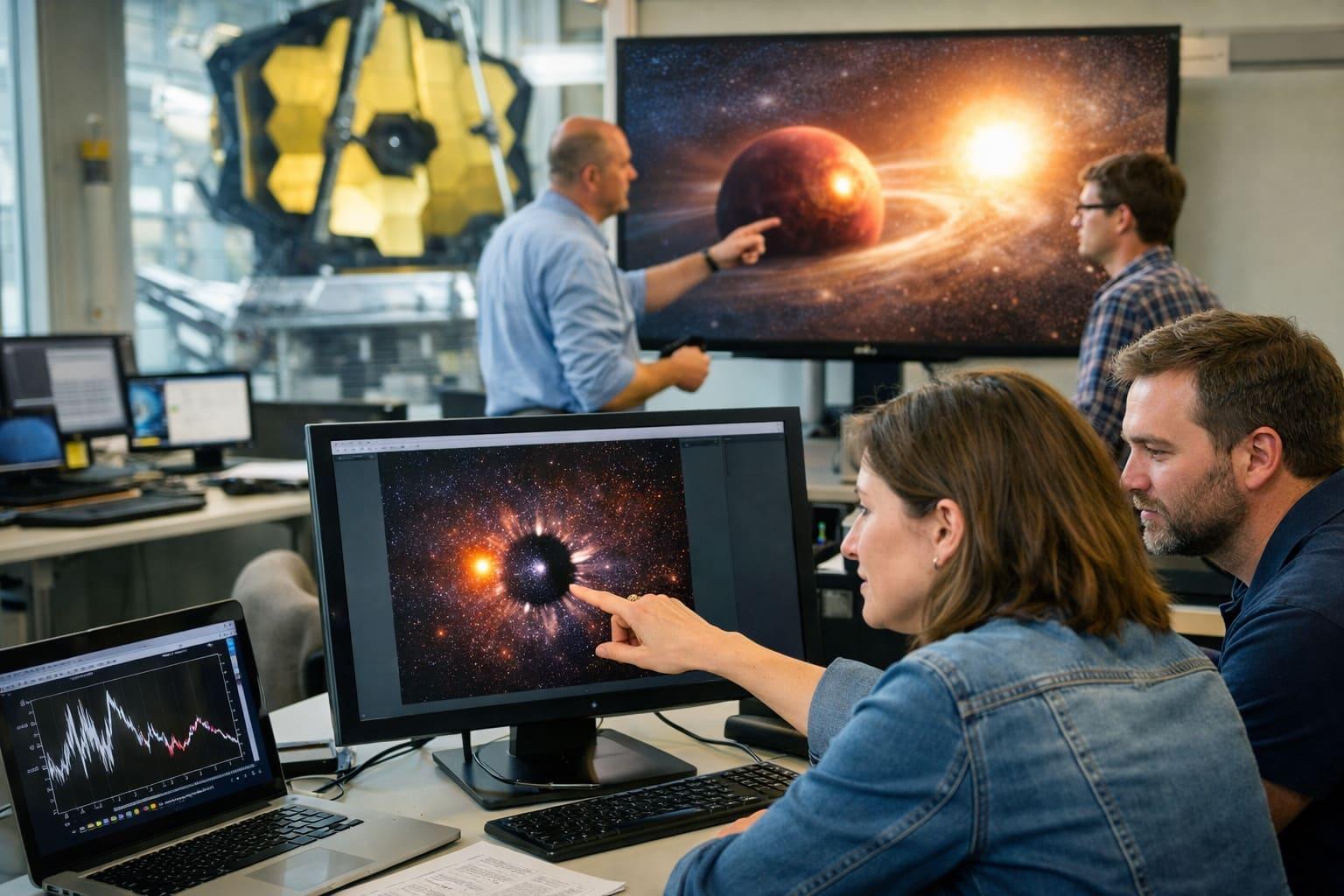
Astronomers utilized NASA’s James Webb Space Telescope (JWST) to directly image 29 Cygni b, a massive exoplanet approximately 15 times the mass of Jupiter. This groundbreaking research, published in The Astrophysical Journal Letters, reveals that 29 Cygni b likely formed through a process of accretion within a protoplanetary disk, a mechanism traditionally associated with planet formation. The research team, led by William Balmer from Johns Hopkins University and the Space Telescope Science Institute, employed Webb’s Near-Infrared Camera (NIRCam) in its coronagraphic mode to capture detailed images of the planet. The findings indicate that 29 Cygni b is enriched with heavy chemical elements such as carbon and oxygen, suggesting it formed from the accumulation of metal-rich solids in a protoplanetary disk. This is significant because it challenges previous assumptions about the formation of massive celestial bodies, which were often thought to arise from gas fragmentation, a process typical for star formation. The planet orbits its host star at an average distance of 1.5 billion miles (2.4 billion kilometers), similar to the distance of Uranus from the Sun. The research team also confirmed that the planet's orbit is aligned with the spin of its host star, further supporting the theory that it formed from a protoplanetary disk. This alignment is consistent with the formation processes observed in our own solar system, where planets typically share a common orbital plane with their stars. Balmer's observing program targeted 29 Cygni b as part of a broader effort to understand the formation of massive planets, which sit on the dividing line between planets and stars. The study's results provide new insights into how such massive objects can form and the conditions necessary for their creation, marking a significant advancement in our understanding of planetary formation mechanisms.
Why this matters
Understanding the formation of massive planets like 29 Cygni b is crucial for astrophysics, as it challenges existing theories and provides new insights into the dynamics of planetary systems. The research suggests that the processes governing the formation of massive planets may be more complex than previously thought, potentially leading to a reevaluation of how we classify celestial bodies. This study enhances our knowledge of the conditions necessary for planet formation in various environments across the universe, which is vital for future explorations and the search for habitable worlds. As astronomers continue to investigate the characteristics of exoplanets, findings like these will help refine our models of planetary formation and evolution, ultimately contributing to our understanding of the universe's structure and the potential for life beyond Earth.
What changed
The findings from this research redefine the criteria used to distinguish between planets and stars, particularly for massive objects like 29 Cygni b. The evidence supporting the accretion model for this exoplanet suggests that similar massive planets may also form through this process, rather than through the traditional star formation mechanisms that involve gas fragmentation. This shift in understanding could influence future research and exploration strategies in astrophysics, prompting scientists to reconsider the formation pathways of other massive celestial bodies. The implications of this research extend to the classification of exoplanets and could lead to new frameworks for understanding the diversity of planetary systems observed in the universe. As researchers gather more data, the distinctions between planets and stars may become increasingly nuanced, reflecting the complexities of cosmic formation processes.
Bigger picture
This discovery is part of a broader effort to understand the complexities of planetary formation and the characteristics that define celestial bodies. As telescopes like the James Webb Space Telescope continue to provide unprecedented views of the universe, researchers are gaining insights that could reshape our understanding of how planets and stars evolve. The implications of this research extend beyond our solar system, potentially influencing the search for habitable worlds and the study of exoplanetary systems across the galaxy. The ability to directly image and analyze the atmospheres of exoplanets like 29 Cygni b opens new avenues for understanding the chemical compositions and formation histories of distant worlds. As more data is collected, scientists hope to uncover the relationships between planetary mass, composition, and formation mechanisms, which could lead to a more comprehensive understanding of the universe's architecture. This research not only enhances our knowledge of planetary systems but also informs the ongoing quest to find life beyond Earth, as understanding the formation and characteristics of planets is essential for identifying potentially habitable environments.
Looking Towards the Future
Future studies will focus on gathering more data on other targets within the same observational program, which may reveal compositional differences among planets of varying masses. Observations from the James Webb Space Telescope will continue to play a crucial role in advancing our understanding of planetary formation and the characteristics of celestial bodies. Researchers will be particularly interested in how the findings from 29 Cygni b compare to other exoplanets, especially those that fall on either side of the mass spectrum. As the JWST continues its mission, the astronomical community will be watching closely for new discoveries that could further illuminate the processes that govern the formation and evolution of planets in our galaxy.
Story timeline
Research Publication
Findings on 29 Cygni b published in The Astrophysical Journal Letters.
Webb Imaging
NASA's Webb Telescope captures images of 29 Cygni b.
Formation Insights
Research reveals new insights into the formation of massive planets.
Sources behind this brief
2 total
NASA
Original article detailing the findings from the James Webb Space Telescope.
Phys.org RSS
Corroborating article discussing the implications of the research.
Further reading on this topic
2 links
Context zone
USA
Context zone
USA
On this map
NASA’s Webb Redefines Dividing Line Between Planets, Stars
USA
Volunteers Discover Rare Space Weather Events Using Their Ears
USA
NASA's HARP project has engaged volunteers to listen to space weather phenomena, leading to unexpected discoveries about plasma waves. Participants translated magnetic field data into sound, revealing anomalies in wave patterns that challenge previous scientific expectations. This citizen science initiative not only enhances understanding of space weather but also inspires participants to pursue scientific careers.
Roman Space Telescope Launching in September
USA
NASA has announced that the Nancy Grace Roman Space Telescope is set to launch in September 2026, ahead of schedule and under budget. This telescope will complement the James Webb Space Telescope by surveying the universe broadly, identifying targets for more detailed examination. Named after NASA's first Chief of Astronomy, Nancy Grace Roman, the telescope aims to uncover new insights about the universe, including the nature of dark energy and the expansion of the cosmos.
NASA’s Hubble Dazzles With Young Stars in Trifid Nebula
USA
NASA celebrates the 36th anniversary of the Hubble Space Telescope with a stunning new image of the Trifid Nebula, showcasing its vibrant star-forming region. The telescope's advanced capabilities allow for detailed observations of changes in the nebula over time, revealing the dynamic processes of star formation. This latest image highlights the impact of massive stars on their surroundings, triggering new waves of star birth.
NASA’s Perseverance, Curiosity Panoramas Capture Two Sides of Mars
United States
NASA's Curiosity and Perseverance rovers have unveiled stunning 360-degree panoramas of Mars, showcasing the planet's diverse geological history. Curiosity explores younger terrains while Perseverance investigates some of the oldest landscapes, revealing insights into Mars' past and potential for life. These images highlight the rovers' contributions to understanding the Red Planet's formation and ancient environments.
Artemis II astronauts say landing on the Moon is "absolutely doable" soon
United States
The Artemis II crew expressed confidence in landing on the Moon, stating it is 'absolutely doable' following their successful mission. The astronauts, energized by NASA's plans for a lunar base, highlighted their readiness for future lunar operations. Their mission marked a significant step in NASA's Artemis program, aiming for sustained human presence on the Moon.
NASA’s Curiosity Finds Organic Molecules Never Seen Before on Mars
United States
NASA's Curiosity rover has discovered the most diverse collection of organic molecules on Mars, including seven never seen before. This significant finding suggests that ancient Mars had the right chemistry to support life. The results were published in Nature Communications, highlighting the potential for future exploration and understanding of Martian chemistry.