NASA’s Hubble Dazzles With Young Stars in Trifid Nebula
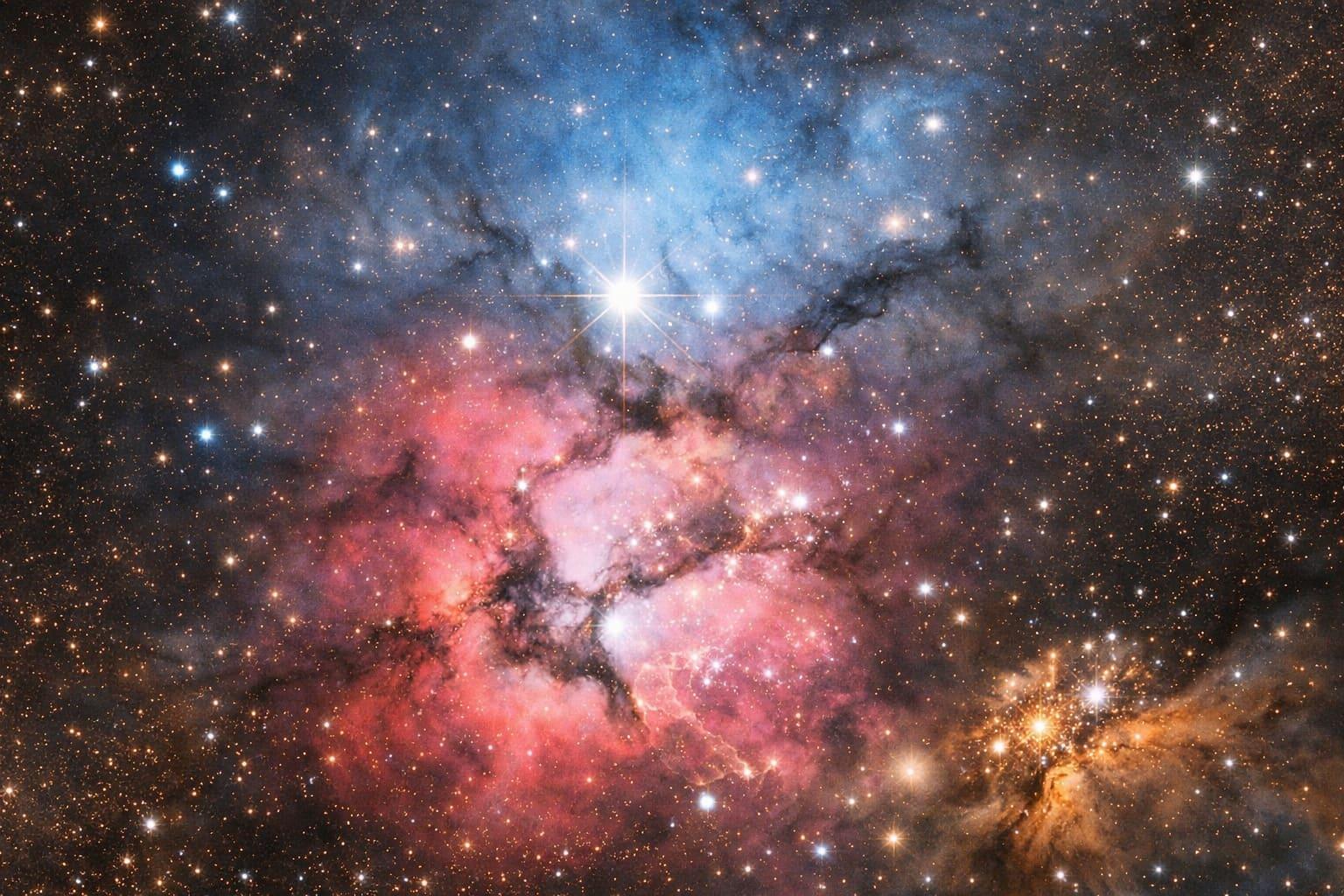
NASA celebrates the 36th anniversary of the Hubble Space Telescope with a stunning new image of the Trifid Nebula, showcasing its vibrant star-forming region. The telescope's advanced capabilities allow for detailed observations of changes in the nebula over time, revealing the dynamic processes of star formation. This latest image highlights the impact of massive stars on their surroundings, triggering new waves of star birth.
At a glance
Location and topic
Region
USA
Tag cluster
Trend count
+8 related briefs
What happened
NASA has unveiled a stunning new image of the Trifid Nebula, a vibrant star-forming region located approximately 5,000 light-years from Earth, in celebration of the Hubble Space Telescope's 36th anniversary. This latest image showcases the intricate details of the nebula, revealing how massive stars influence their environment and trigger new star formation. The Trifid Nebula, also known as Messier 20, is characterized by its striking array of colors, reminiscent of an underwater scene filled with fine-grained sediments. The Hubble telescope, equipped with an improved camera, has been able to capture changes in the nebula over nearly three decades, providing a unique perspective on cosmic evolution. The image highlights the effects of powerful ultraviolet light from massive stars, which have shaped the nebula for at least 300,000 years. As these stars emit strong winds, they create bubbles that compress surrounding gas and dust, leading to the birth of new stars. This ongoing process of star formation is a key area of research for astronomers, as it helps to unravel the complexities of the universe. Hubble's observations reveal a dynamic interplay between the massive stars and the gas and dust in the nebula, showcasing the intricate processes that govern star formation. The telescope's ability to capture these processes over time allows scientists to study the interactions between stars and their environments, providing insights into the lifecycle of stars and the evolution of galaxies. The Trifid Nebula serves as a prime example of the processes that govern star formation in the universe, making it a focal point for ongoing astronomical research.
Why this matters
Understanding star formation is crucial for comprehending the evolution of galaxies and the universe as a whole. The Trifid Nebula, with its ongoing star formation processes, provides a unique laboratory for studying these phenomena. Hubble's ability to capture these processes over time allows scientists to analyze the interactions between stars and their environments, leading to advancements in astrophysics. This knowledge can inform future explorations of space and enhance our understanding of the universe's structure and dynamics. The insights gained from studying the Trifid Nebula can also have broader implications for understanding the formation of other celestial bodies and the conditions necessary for life. As researchers continue to analyze Hubble's data, they are likely to uncover new information that could reshape our understanding of cosmic evolution and the fundamental processes that govern the universe.
What changed
The latest observations from Hubble have provided a clearer view of the Trifid Nebula, showcasing changes that have occurred since its first capture in 1997. The improved camera technology, specifically the Wide Field Camera 3 installed during Servicing Mission 4, has enhanced the telescope's ability to detect finer details and changes in the nebula's structure. This advancement allows researchers to measure the dynamics of star formation more accurately and understand the impact of massive stars on their surroundings. The new image reveals intricate features such as jets of plasma ejected by young protostars and the effects of ultraviolet light on the surrounding gas and dust. These observations enable scientists to track the evolution of the nebula and the processes that drive star formation, providing valuable data for ongoing research in astrophysics. The ability to revisit the same celestial objects over time is a significant advantage of Hubble's long operational lifetime, allowing for a deeper understanding of cosmic phenomena and the changes that occur within them.
Bigger picture
The Trifid Nebula serves as a prime example of the processes that govern star formation in the universe. As one of the most studied regions in the sky, it offers valuable insights into how stars are born and evolve. Hubble's long-term observations contribute to a broader understanding of cosmic phenomena, helping to bridge gaps in our knowledge of stellar and galactic evolution. The nebula's dynamic environment, shaped by the powerful winds and radiation from massive stars, illustrates the complex interactions that occur in star-forming regions. This research not only enriches our understanding of the universe but also inspires future generations of astronomers and scientists. The ongoing study of the Trifid Nebula and similar regions will continue to inform our understanding of the lifecycle of stars and the formation of galaxies. As Hubble continues to operate, it will provide further insights into the processes that govern star formation, potentially leading to new discoveries that could reshape our understanding of the cosmos. The knowledge gained from these observations will be crucial for future missions and advancements in telescope technology, which aim to explore the universe in even greater detail.
History
The Hubble Space Telescope has been a cornerstone of modern astronomy since its launch in 1990. Over the years, it has provided unprecedented views of the universe, contributing to numerous discoveries about galaxies, stars, and planetary systems. The Trifid Nebula, first observed by Hubble in 1997, has been revisited multiple times, allowing scientists to track changes and deepen their understanding of star formation processes. Hubble's ability to capture images across a wide range of wavelengths has revolutionized our understanding of cosmic phenomena, enabling researchers to study the intricate details of star formation and the interactions between stars and their environments. The telescope's legacy is marked by its contributions to our knowledge of the universe, making it an invaluable tool for astronomers and a symbol of human curiosity and exploration.
Looking Towards the Future
As Hubble continues to operate, future observations of the Trifid Nebula and other star-forming regions will likely yield new insights into the lifecycle of stars. Researchers will be monitoring how the dynamics of star formation evolve over time, particularly in response to the influence of massive stars. Upcoming missions and advancements in telescope technology may also enhance our understanding of these cosmic phenomena. The continued study of the Trifid Nebula will provide valuable data for understanding the processes that govern star formation and the evolution of galaxies, contributing to the broader field of astrophysics. As new discoveries emerge, they will not only deepen our understanding of the universe but also inspire future generations of scientists and explorers.
Story timeline
Hubble Launch
The Hubble Space Telescope is launched into orbit.
First Image of Trifid Nebula
Hubble captures its first image of the Trifid Nebula.
Hubble's 36th Anniversary
NASA celebrates Hubble's anniversary with new images of the Trifid Nebula.
Sources behind this brief
2 total
NASA
Original article detailing Hubble's observations.
Phys.org
Corroborating source providing additional context.
Further reading on this topic
2 links
Context zone
USA
Context zone
USA
On this map
NASA’s Hubble Dazzles With Young Stars in Trifid Nebula
USA
Roman Space Telescope Launching in September
USA
NASA has announced that the Nancy Grace Roman Space Telescope is set to launch in September 2026, ahead of schedule and under budget. This telescope will complement the James Webb Space Telescope by surveying the universe broadly, identifying targets for more detailed examination. Named after NASA's first Chief of Astronomy, Nancy Grace Roman, the telescope aims to uncover new insights about the universe, including the nature of dark energy and the expansion of the cosmos.
Astronauts Experience Awe-Inspiring Solar Eclipse from Lunar Orbit
United States
During the Artemis II mission, astronauts witnessed a total solar eclipse from lunar orbit, marking a historic first. This unique perspective allowed them to see the moon completely obscuring the sun, with Earthshine illuminating the lunar surface. Such experiences can profoundly impact astronauts' perceptions of their place in the universe.
NASA Laser Terminal enhances views during Artemis II mission
United States
NASA's Artemis II mission showcased the effectiveness of laser communications, enabling high-definition data transfer between the Orion spacecraft and Earth. The optical terminal transmitted 484 gigabytes of data, significantly improving real-time science operations and public engagement. This advancement marks a pivotal step in enhancing future space missions.
NASA’s Perseverance, Curiosity Panoramas Capture Two Sides of Mars
United States
NASA's Curiosity and Perseverance rovers have unveiled stunning 360-degree panoramas of Mars, showcasing the planet's diverse geological history. Curiosity explores younger terrains while Perseverance investigates some of the oldest landscapes, revealing insights into Mars' past and potential for life. These images highlight the rovers' contributions to understanding the Red Planet's formation and ancient environments.
NASA’s Curiosity Finds Organic Molecules Never Seen Before on Mars
United States
NASA's Curiosity rover has discovered the most diverse collection of organic molecules on Mars, including seven never seen before. This significant finding suggests that ancient Mars had the right chemistry to support life. The results were published in Nature Communications, highlighting the potential for future exploration and understanding of Martian chemistry.