Molecular Quantum Nanosensors Reveal Temperature and Radical Signals Inside Living Cells
Researchers from Japan have developed biocompatible molecular quantum nanosensors (MoQNs) that can operate within living cells. These nanosensors allow for precise temperature measurements and radical detection at a subcellular level, enhancing our understanding of cellular environments. The findings, published in Science Advances, could lead to significant advancements in biomedical research and therapies.
At a glance
Location and topic
Region
Japan
Tag cluster
Trend count
+3 related briefs
What happened
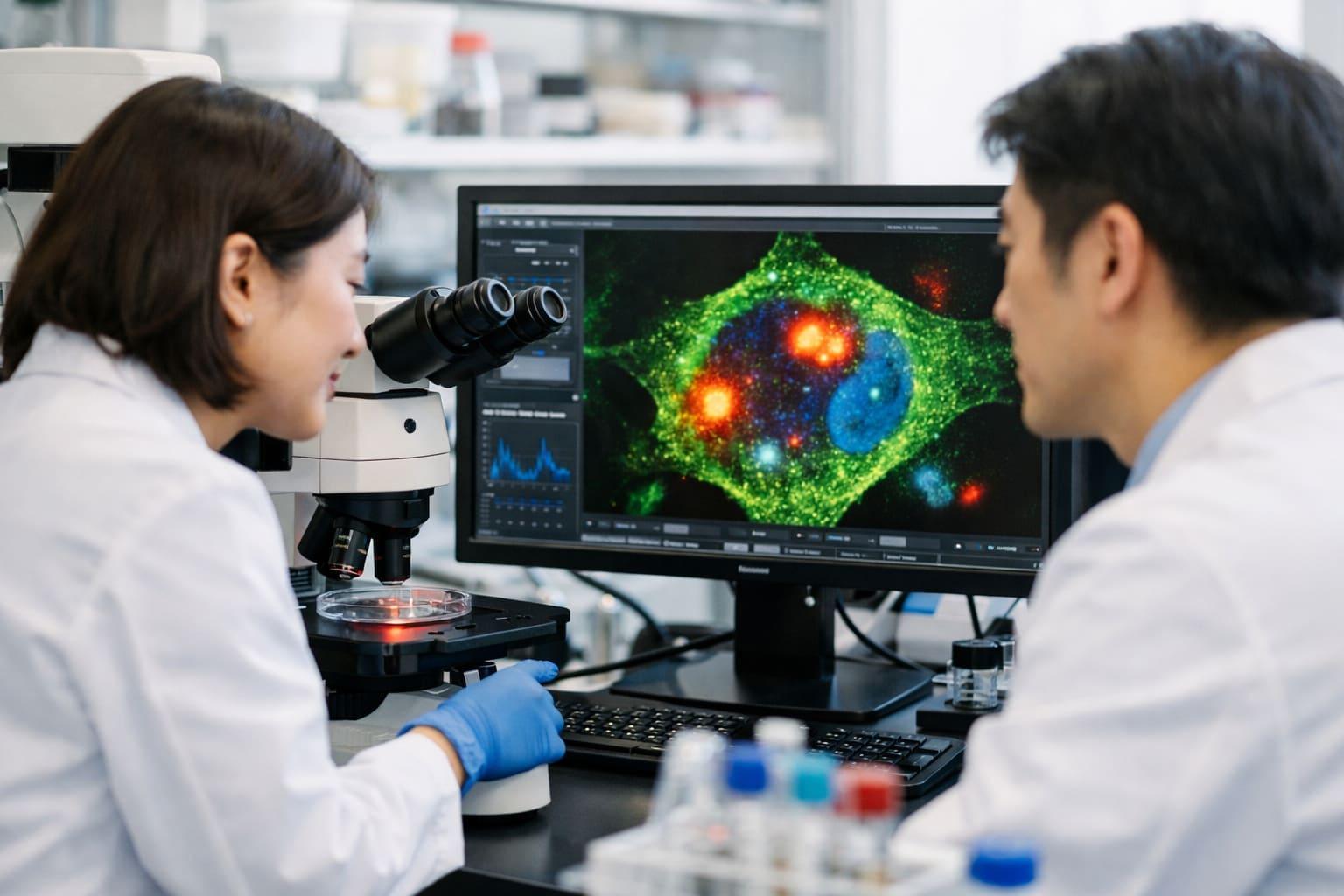
Researchers at the National Institutes for Quantum Science and Technology (QST) and The University of Tokyo, in collaboration with Kyushu University, have developed a groundbreaking class of biocompatible molecular quantum nanosensors (MoQNs) capable of functioning inside living cells. This innovative technology allows for precise measurements of absolute temperature and the detection of radical-related signals, addressing significant challenges in cellular sensing that have long hindered biological research. The findings were published in the journal Science Advances, marking a significant milestone in the field of nanotechnology and biomedicine. The MoQNs are constructed using pentacene molecular spin qubits embedded in para-terphenyl nanocrystals, which are then coated with the biocompatible surfactant Pluronic F127. This design not only ensures molecular-level uniformity but also preserves quantum coherence under physiological conditions, a critical factor for accurate measurements. Traditional intracellular quantum sensors, such as nanodiamonds and quantum dots, often suffer from issues related to material heterogeneity and biocompatibility, which the MoQNs effectively overcome. To validate the functionality and compatibility of these nanosensors, the research team conducted a series of assays demonstrating that MoQNs could be introduced into living cells without compromising cell viability. The cells maintained their plasma membrane integrity, metabolic activity, and cell-cycle progression, indicating that the MoQNs are suitable for live-cell measurements. The researchers also confirmed that the MoQNs retain their quantum functionality within the cellular environment, showcasing capabilities such as continuous-wave optically detected magnetic resonance (ODMR) detection, Rabi oscillations, spin-echo measurements, and T1 relaxometry. Using deuterated MoQNs (dMoQNs), the team achieved high-precision temperature sensing within the cytoplasm of living cancer cells, revealing that intracellular temperatures were consistently higher than those of the surrounding medium. Furthermore, the researchers extended their measurements to the nuclei of these cells, mapping absolute temperature at various intranuclear positions and uncovering localized thermal heterogeneity within the nucleus. This capability represents a significant advancement in our understanding of cellular environments and their dynamics. In addition to temperature sensing, the MoQN platform also enabled the detection of radical-related external spins within living cells. By inducing radical-generating conditions using hydrogen peroxide, the researchers observed changes in spin relaxation and coherence, indicating that the sensors can effectively report on intracellular redox-associated environments alongside temperature measurements. This dual functionality establishes MoQNs as a versatile tool for quantum sensing in biological contexts, paving the way for future applications in medical diagnostics and research.
Why this matters
The development of molecular quantum nanosensors (MoQNs) is a significant advancement in the field of cellular biology, as it enhances our ability to study the intricate environments within living cells with unprecedented precision. This technology could lead to breakthroughs in understanding the mechanisms of various diseases, particularly cancer, by allowing researchers to monitor cellular conditions in real-time. The ability to measure temperature and detect radical signals simultaneously provides a more comprehensive view of cellular processes, which is crucial for developing targeted therapies. Moreover, the MoQNs' biocompatibility ensures that they can be safely used in live-cell experiments, which is essential for translating laboratory findings into clinical applications. As personalized medicine continues to gain traction, the insights gained from using MoQNs could facilitate the development of tailored treatment strategies that improve patient outcomes. By enabling researchers to observe and quantify changes in cellular environments, MoQNs represent a powerful tool for advancing our understanding of biology and medicine.
What changed
The introduction of molecular quantum nanosensors (MoQNs) marks a transformative shift in the field of cellular sensing. Unlike traditional sensors, which often struggle with issues of precision and biocompatibility, MoQNs provide a more reliable and accurate method for measuring temperature and detecting radicals within living cells. This innovation not only enhances our understanding of cellular processes but also opens new avenues for research in biomedicine, particularly in cancer studies. The ability to achieve high-precision temperature mapping and radical detection at a subcellular level represents a significant leap forward in our capacity to investigate the dynamic environments of living cells. This advancement could lead to more effective diagnostic tools and therapeutic strategies, particularly in the context of diseases where cellular temperature and oxidative stress play critical roles. The MoQNs' unique design and functionality set them apart from existing technologies, positioning them as a vital resource for future research and clinical applications.
Bigger picture
The development of molecular quantum nanosensors (MoQNs) aligns with the broader trend of integrating quantum technology into biological research, a field that has seen rapid advancements in recent years. As scientists strive to unravel the complexities of cellular processes, tools that offer high precision and biocompatibility are becoming increasingly essential. The ability to monitor intracellular environments in real-time could lead to significant advancements across various fields, including drug development, cancer research, and personalized medicine. This breakthrough exemplifies the potential of quantum technology to transform our approach to biological and medical challenges. By providing researchers with the means to conduct detailed studies of cellular dynamics, MoQNs could facilitate the discovery of new biomarkers and therapeutic targets, ultimately improving patient care. Furthermore, as the field of quantum biology continues to evolve, the insights gained from using MoQNs may inspire the development of even more sophisticated sensing technologies, further enhancing our understanding of life at the molecular level. In the context of ongoing global health challenges, such as the COVID-19 pandemic and the rising incidence of chronic diseases, the ability to accurately monitor and manipulate cellular environments could prove invaluable. The integration of quantum sensors into biomedical research represents a promising frontier that could yield transformative insights and innovations in healthcare.
History
The journey toward advanced cellular sensing has evolved significantly over the past few decades. Traditional methods, such as fluorescent proteins and quantum dots, often faced limitations in terms of precision, biocompatibility, and the ability to operate within living cells. The emergence of quantum technology has opened new avenues for research, allowing scientists to explore cellular environments at unprecedented levels of detail. The development of molecular quantum nanosensors (MoQNs) represents a culmination of these efforts, showcasing the potential of quantum sensors in biological applications. Historically, the integration of nanotechnology into biology has been driven by the need for more effective tools to study complex biological systems. As researchers have sought to understand the intricate interactions within cells, the demand for sensors that can provide real-time, high-resolution data has grown. The MoQNs developed by the QST and The University of Tokyo exemplify this trend, offering a novel solution to longstanding challenges in cellular sensing and paving the way for future innovations in the field.
Looking Towards the Future
As research continues, it will be important to monitor the applications of molecular quantum nanosensors (MoQNs) across various fields, particularly in cancer research and personalized medicine. Future studies may explore the full potential of these nanosensors in diagnosing diseases, monitoring treatment responses, and understanding the underlying mechanisms of cellular processes. Additionally, advancements in quantum technology could lead to further innovations in cellular sensing and other biomedical applications, potentially revolutionizing how we approach health and disease management. Researchers will likely investigate the scalability of MoQNs for broader applications, including their use in clinical settings. The ongoing exploration of their capabilities may also inspire the development of new quantum-based tools that enhance our understanding of biological systems. As the field progresses, the implications of MoQNs for improving patient outcomes and advancing medical research will be closely watched.
Story timeline
Publication of Research
The study on molecular quantum nanosensors is published in Science Advances.
Development of MoQNs
Researchers at QST and The University of Tokyo develop a new class of nanosensors for cellular applications.
Validation of Cellular Compatibility
The research team confirms that MoQNs can be introduced into living cells without compromising viability.
Sources behind this brief
2 total
Phys.org
Original article on the development of molecular quantum nanosensors.
Science Advances
Publication of the research study detailing the findings on MoQNs.
Further reading on this topic
5 links
Cambridge Open Engage
An early research output introducing molecular quantum nanosensors (MQNs) for intracellular quantum measurement of absolute temperature.
PubMed
A study presenting a bifunctional nanoprobe capable of simultaneous measurement of reactive oxygen species and temperature within single cells.
PubMed
Research on graphene quantum dots as intracellular imaging-based temperature sensors.
PubMed
Demonstration of real-time temperature monitoring inside living organisms using quantum nanothermometers based on nanodiamonds.
Max Planck Institute for Polymer Research
Information on nanodiamond sensors and actuators for probing free radical biology and cellular environments.
Context zone
Japan
Context zone
Japan
On this map
Molecular Quantum Nanosensors Reveal Temperature and Radical Signals Inside Living Cells
Japan