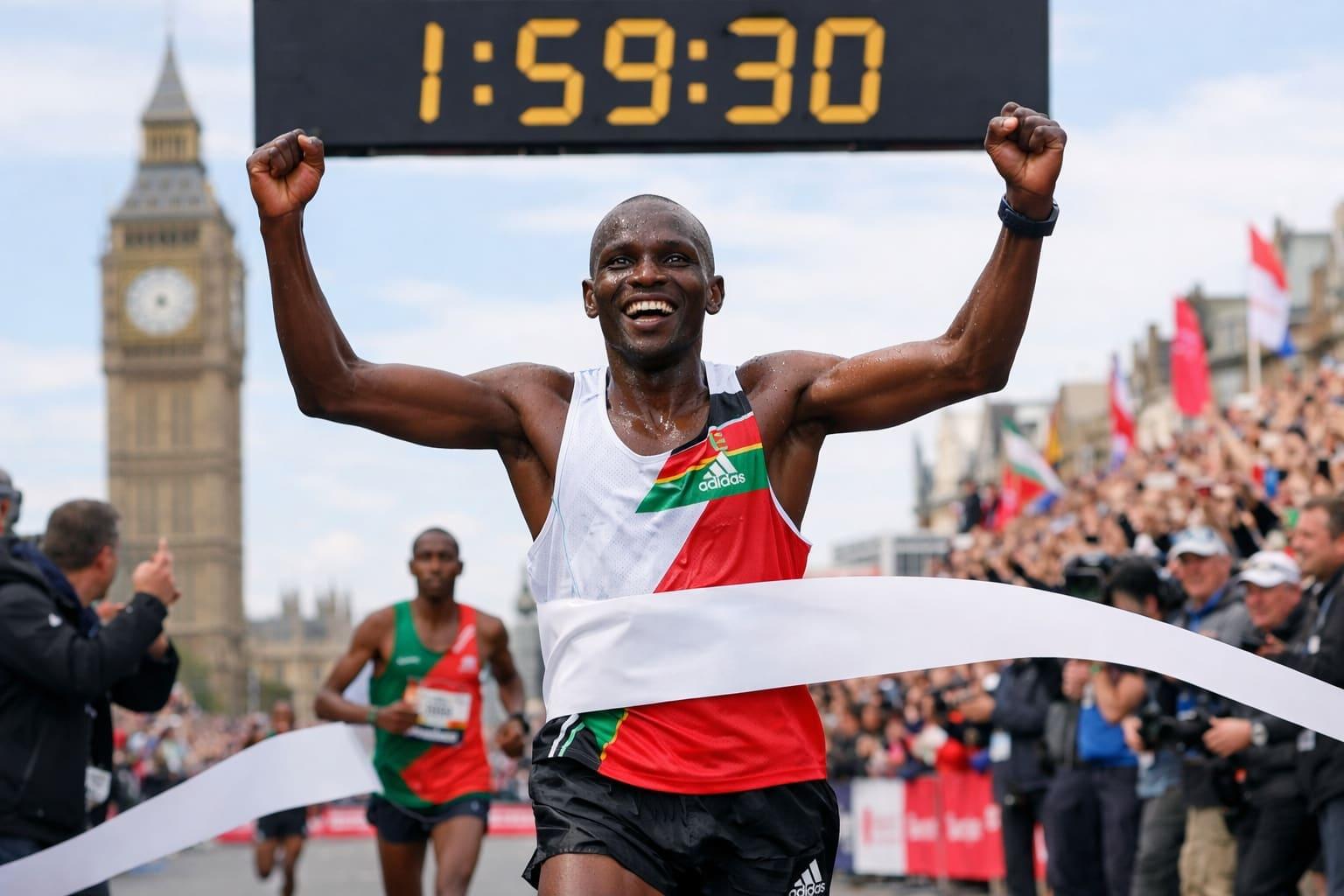
Sabastian Sawe breaks two-hour barrier to make history in London Marathon
Kenyan runner Sabastian Sawe has made history by breaking the two-hour barrier in the London Marathon, finishing with a time of 1:59:30. This remarkable achievement not only sets a new world record but also positions Sawe among the greatest athletes in marathon history. His performance has sparked comparisons to legendary feats in athletics, showcasing the evolution of marathon running.
The story
On April 26, 2026, Sabastian Sawe made history by completing the London Marathon in an astonishing time of 1 hour, 59 minutes, and 30 seconds, becoming the first person to officially run a marathon in under two hours. This remarkable feat not only shattered the previous world record of 2:00:35, held by Kelvin Kiptum, but also showcased Sawe's extraordinary endurance and speed, particularly in the latter stages of the race. The 31-year-old Kenyan's performance was nothing short of breathtaking, as he maintained an average pace that would require running 100 meters in under 17 seconds for the entire 42 kilometers. The day was marked by ideal weather conditions, which contributed to the fast times recorded by several runners. Sawe's team had expressed confidence in his preparation, attributing part of his success to the new Adidas Adios Pro 3 supershoes, which are the lightest in history at just 97 grams. After crossing the finish line, Sawe expressed his joy, stating, "I am feeling good, I am so happy. It is a day to remember. I have shown that nothing is not possible." His victory not only earned him a world record but also a financial windfall, reportedly exceeding $1 million in prize money and bonuses. Remarkably, two other runners also finished under Kiptum's previous record, with Ethiopian Yomif Kejelcha completing his debut marathon in 2:00:41 and Jacob Kiplimo finishing in 2:00:28. The race unfolded with Sawe and Kejelcha running a blistering 5 kilometers between 30 and 35 kilometers in just 13:54, and they maintained an incredible pace, covering the final kilometers in record time. Sawe's achievement is particularly significant as it came on a course that is not traditionally known for fast times, further emphasizing the magnitude of his performance. This marathon was not just a race; it was a historic moment that will be remembered for years to come.
Why it matters
Sawe's groundbreaking achievement is a testament to the limits of human potential and the relentless pursuit of excellence in sports. Breaking the two-hour barrier in marathon running serves as a motivational milestone for athletes worldwide, demonstrating that goals once thought unattainable can indeed be achieved. This record is likely to inspire a new generation of runners to push their limits and strive for greatness. Furthermore, Sawe's victory may influence future training methodologies and competitive strategies in long-distance running, as athletes and coaches analyze the factors that contributed to his success. The implications of this record extend beyond individual achievement; it raises questions about the evolution of marathon running and the role of technology in enhancing performance. As the sport continues to evolve, Sawe's accomplishment will likely serve as a benchmark for future athletes aiming to redefine the boundaries of marathon running.
Evidence and context
Sawe's record is not merely a personal triumph; it represents a significant moment in the evolution of marathon running and the broader landscape of athletics. As athletes continue to push the boundaries of human performance, this achievement may inspire a new generation of runners to strive for greatness. The advancements in sports science, nutrition, and technology, particularly in footwear, are likely to play a crucial role in shaping the future of long-distance running. Sawe's accomplishment highlights the growing global interest in marathons, as cities around the world host increasingly competitive races. The London Marathon, in particular, has become a focal point for elite runners, and Sawe's record will undoubtedly elevate the event's status in the international running community. This moment also underscores the importance of community and support systems in athletics, as Sawe's journey from a remote village in Kenya to the world stage exemplifies the transformative power of sport. As the running community reflects on this historic achievement, it is essential to consider the implications for future competitions, athlete development, and the ongoing quest for excellence in marathon running. The excitement generated by Sawe's performance may lead to a surge in participation in marathons globally, as aspiring runners seek to emulate his success and challenge themselves in the sport.
Limits and unknowns
The quest to break the two-hour marathon barrier has been a long-standing goal in athletics, with various attempts made over the years. The first unofficial sub-two-hour marathon was achieved by Eliud Kipchoge in 2019 during the INEOS 1:59 Challenge, but it did not count as a world record due to the controlled conditions under which it was run. Kipchoge's achievement sparked a renewed interest in marathon running and set the stage for future attempts to break this elusive barrier. Sawe's achievement marks a pivotal moment in this ongoing narrative, showcasing the culmination of years of training, innovation, and determination. The history of marathon running is filled with remarkable feats, and Sawe's record will undoubtedly be remembered as a significant milestone in the sport's evolution. As athletes continue to strive for excellence, the legacy of Sawe's accomplishment will inspire future generations to push the limits of what is possible in marathon running.
What happens next
As the running community reacts to Sawe's historic achievement, attention will likely turn to upcoming marathons and the athletes aiming to challenge this new record. Observers should keep an eye on major events such as the Berlin Marathon and the Chicago Marathon, where elite runners will be eager to test their mettle against Sawe's time. Additionally, advancements in running technology and training techniques are expected to emerge in response to this milestone, as athletes and coaches seek to leverage new innovations to enhance performance. Discussions around doping regulations and athlete integrity are also anticipated to intensify as the sport evolves, particularly in light of Sawe's commitment to transparency regarding testing. The impact of Sawe's record will resonate throughout the athletics community, influencing not only competitive strategies but also the broader narrative surrounding marathon running and its future.
Follow the story
Share it, watch the explainer, or continue with the reporting trail.
Story timeline
BBC World
Sawe smashes two-hour mark to 'move goalposts for marathon running'
Sawe breaks two-hour barrier
Sabastian Sawe completes the London Marathon in 1:59:30, breaking the two-hour barrier.
Previous world record
Kelvin Kiptum set the previous marathon world record at 2:00:35.
Kipchoge's unofficial record
Eliud Kipchoge runs a marathon in under two hours (1:59:40) but under non-regulated conditions.
Further reading on this topic
3 links
Sabastian Sawe breaks two-hour barrier to make history in London Marathon
A short visual explainer for readers who want the story in a different rhythm.