Tiny Grain-of-Rice Sensor Enhances Robotic Sensitivity
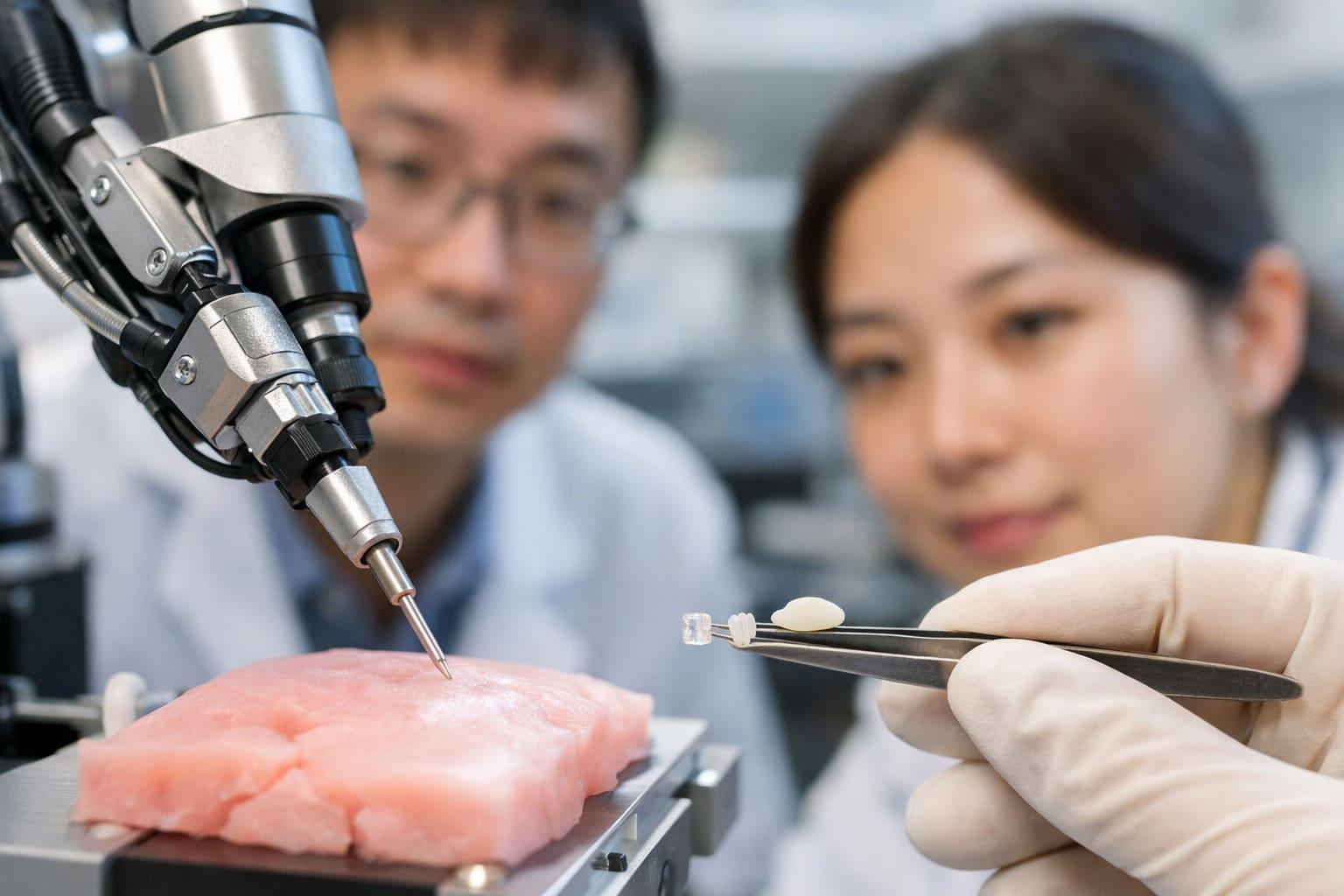
Researchers have developed a miniature sensor, the size of a grain of rice, that can measure forces and torque in all directions using light. This innovation could significantly improve the sensitivity of robotic tools and medical devices, allowing them to detect physical interactions more effectively. The sensor's compact design makes it suitable for delicate applications, particularly in minimally invasive surgeries.
At a glance
Location and topic
Region
China
Tag cluster
Trend count
+1 related briefs
What happened
Researchers at Shanghai Jiao Tong University have developed a revolutionary sensor measuring just 1.7 millimeters, comparable to the size of a grain of rice, that utilizes light to detect forces and torque in all directions. This innovative sensor represents a significant advancement over traditional sensors, which are often bulky and complex, making them unsuitable for miniature tools. The new device employs a single optical signal to provide real-time feedback on physical interactions, which is crucial for applications requiring high precision, such as robotic surgery. According to Jianlong Yang, the lead researcher, existing imaging systems can clearly show structures but fail to provide information about physical interactions like force or torque. This new sensor addresses that gap by allowing machines to measure contact force, pressure, shear, and twisting, which could significantly enhance the functionality of robotic tools and medical devices. In proof-of-concept tests, the sensor demonstrated its capability to detect variations in stiffness and locate hidden structures, such as tumors within tissue models. This feature is particularly valuable in minimally invasive surgeries, where precision is paramount to avoid damaging surrounding tissues. The researchers conducted experiments using a controlled setup where known forces and torques were applied while recording the sensor's optical response. They achieved accurate and repeatable measurements with low hysteresis, meaning the sensor produced nearly identical readings during loading and unloading, even under complex loading conditions. The next steps for the research team involve transitioning from laboratory validation to practical applications by improving manufacturing consistency and integrating the sensor into relevant tools and robotic systems. They aim to ensure reliable performance at scale and package the system into a compact, user-friendly form that can be easily deployed in medical and industrial settings.
Why this matters
The development of this sensor represents a significant leap in optical sensing technology, particularly for applications in robotics and medicine. By enabling machines to detect subtle physical interactions, it enhances their operational capabilities and safety. This innovation could lead to more effective and less invasive medical procedures, ultimately improving patient outcomes. The ability to measure forces and torques in real-time allows robotic systems to adjust their actions dynamically, reducing the risk of accidental damage during delicate operations. This is especially critical in environments where precision is essential, such as in surgeries involving sensitive tissues or in robotic applications that require fine motor skills. As the technology matures, it could pave the way for a new generation of robotic tools that are not only more compact but also smarter, capable of making real-time adjustments based on tactile feedback. This could revolutionize fields ranging from healthcare to manufacturing, where the need for precision and adaptability is paramount.
What changed
The introduction of this sensor marks a significant shift from traditional electronic sensors to optical sensing methods in robotics. This change simplifies the design and reduces the size of sensors, making them more suitable for delicate tasks. Unlike conventional miniature force sensors that rely on multiple sensing elements and complex structures, this new sensor captures the overall contact state in a single step. This streamlined approach not only enhances the sensor's performance but also opens up new possibilities for integrating sensing capabilities into compact tools. As the technology matures, it is expected to lead to the development of more compact and efficient robotic tools that can perform complex tasks with greater precision. The implications of this shift extend beyond robotics; it could influence the design of various devices across industries, including consumer electronics, where tactile feedback is essential for user interaction. The potential for widespread adoption of this technology could redefine how we approach sensor design and application in numerous fields.
Bigger picture
This advancement in sensor technology aligns with broader trends in robotics and medical technology, where precision and miniaturization are increasingly important. As industries seek to improve the safety and effectiveness of robotic systems, innovations like this sensor could play a crucial role in enhancing operational capabilities. The potential applications extend beyond medicine, impacting various fields such as manufacturing, automation, and even consumer electronics, where tactile feedback is essential for user interaction. The ability to integrate such sensors into robotic systems could lead to more intuitive and responsive machines, capable of performing tasks that require a high degree of sensitivity and adaptability. Furthermore, as the demand for minimally invasive surgical techniques continues to grow, the need for advanced sensing technologies that can provide real-time feedback will become even more critical. This sensor could serve as a foundational technology for future developments in surgical robotics, enabling procedures that are not only safer but also more effective. The ongoing research and development in this area will likely yield further innovations that enhance the capabilities of robotic systems, making them indispensable tools in various sectors.
History
The evolution of sensors has been pivotal in advancing technology across multiple fields. From early mechanical sensors to today's sophisticated electronic and optical devices, each innovation has contributed to improved precision and functionality. The development of miniature sensors, particularly in the context of robotics and medical applications, reflects a growing demand for tools that can operate effectively in constrained environments, a trend that has accelerated in recent years. Historically, sensors have transitioned from bulky mechanical devices to compact electronic systems, and now to advanced optical technologies. This trajectory highlights the importance of miniaturization and efficiency in modern engineering. The emergence of optical sensors, like the one developed by the Shanghai Jiao Tong University team, signifies a new chapter in this evolution, where light-based technologies are set to redefine the capabilities of sensing devices in critical applications.
Looking Towards the Future
As researchers continue to refine this sensor technology, it will be important to monitor its integration into practical applications, particularly in surgical robotics. Future developments may include enhancements in manufacturing processes and the exploration of new use cases across various industries. Observing how this technology influences the design of robotic tools and medical devices will provide insights into its broader impact. Additionally, the potential for commercialization will depend on the ability to scale production while maintaining performance standards. Stakeholders in the medical and robotics fields should keep an eye on upcoming trials and demonstrations that showcase the sensor's capabilities in real-world scenarios. The success of this technology could lead to a paradigm shift in how robotic systems are designed and utilized, ultimately enhancing their effectiveness in critical applications.
Story timeline
Sensor Development
Researchers at Shanghai Jiao Tong University announce the development of a grain-of-rice-sized sensor.
Initial Testing
The sensor undergoes proof-of-concept tests demonstrating its ability to detect forces and torques.
Future Applications
Plans are made to integrate the sensor into robotic tools and medical devices for practical use.
Sources behind this brief
2 total
Phys.org
Original article detailing the sensor's development and applications.
Optica
Peer-reviewed publication discussing the sensor's capabilities.
Further reading on this topic
3 links
Optica Publishing Group
Official announcement detailing the development of the grain-sized optical sensor for force and torque measurement.
Shanghai Jiao Tong University Global College
Overview of research areas at Shanghai Jiao Tong University, including electromagnetics, optics, and photonics.
Optical Science and Engineering Research Center, Shanghai Jiao Tong University
Information about the Optical Science and Engineering Research Center at Shanghai Jiao Tong University.
Context zone
China
Context zone
China
On this map
Tiny Grain-of-Rice Sensor Enhances Robotic Sensitivity
China
No other published articles from this region yet. This marker anchors the story for future regional clustering.