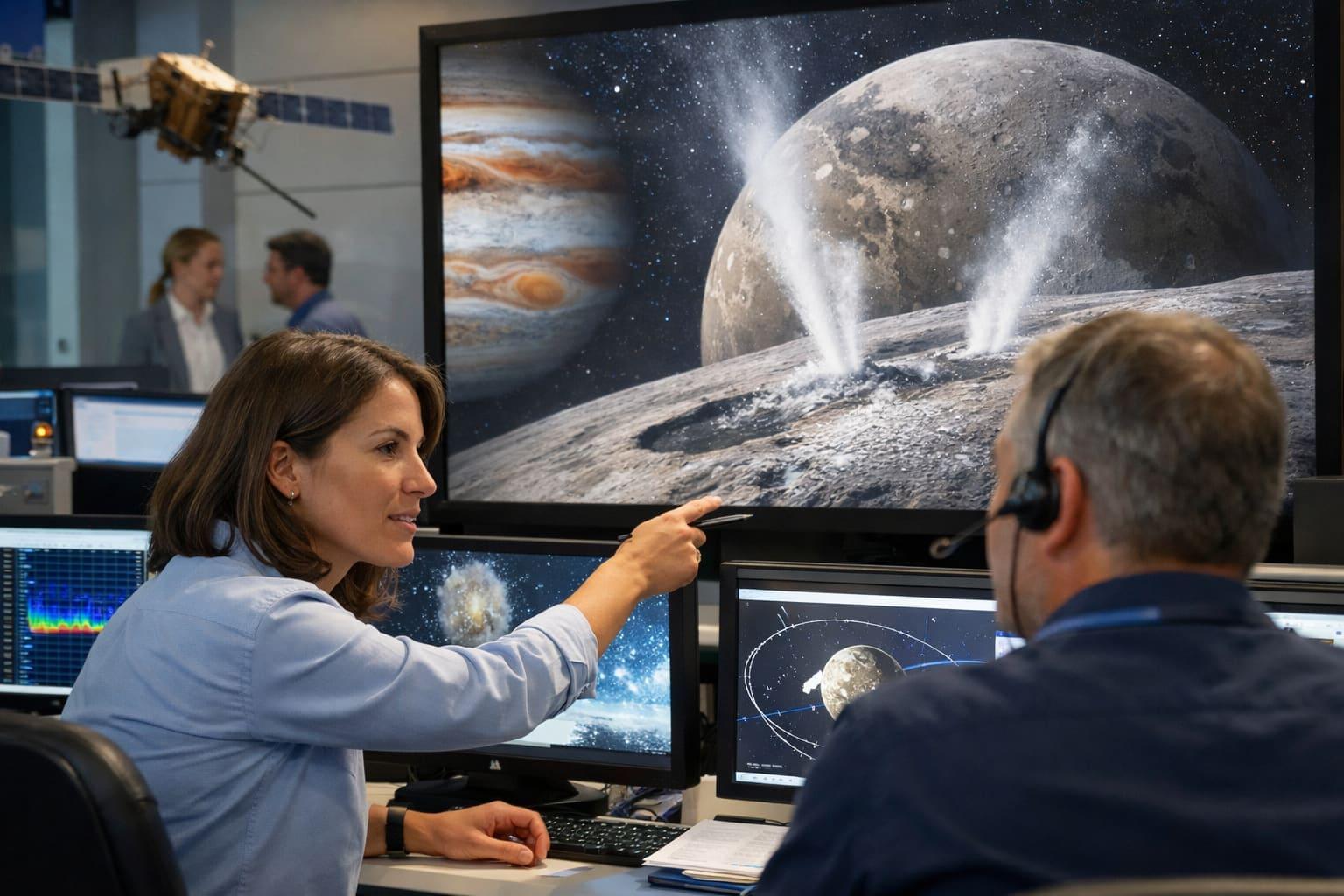
Study identifies geysers the JUICE mission could explore on Ganymede
An international team has pinpointed potential cryovolcanic regions on Ganymede, Jupiter's largest moon, for the upcoming JUICE mission. This study aims to investigate these sites for signs of habitability, utilizing advanced spectrometers to analyze surface features that may indicate subsurface water and organic materials. The findings could enhance our understanding of ocean worlds and their potential to support life.
The story
A recent study led by Dr. Anezina Solomonidou from the Hellenic Space Center has pinpointed several promising cryovolcanic regions on Ganymede, Jupiter's largest moon, which are set to be explored by the European Space Agency's Jupiter Icy Moons Explorer (JUICE) mission. This international research team, which includes scientists from Greece, France, Italy, Germany, the United States, Czechia, the European Space Agency (ESA), and NASA's Jet Propulsion Laboratory (JPL), utilized reprocessed data from the Near-Infrared Mapping Spectrometer (NIMS) aboard NASA's Galileo spacecraft, which operated from 1995 to 2003. The study, titled "Potential Cryovolcanic Regions on Ganymede: A Priority Target for JUICE," has been accepted for publication in The Planetary Science Journal. The researchers focused on identifying unusual surface depressions and structures that may indicate cryovolcanic activity, which is similar to volcanic activity on Earth but involves the eruption of water and other volatiles from beneath the icy surface. Among the most promising candidates for exploration are four specific paternae—depressions that may serve as vents for subsurface water and volatiles. These sites are of particular interest because they could harbor organic materials and biosignatures, which are indicators of potential life. The JUICE mission, scheduled to arrive at Ganymede in the 2030s, will utilize advanced instruments, including the Moons And Jupiter Imaging Spectrometer (MAJIS) and the Jovis, Amorum ac Natorum Undique Scrutator (JANUS), to investigate these cryovolcanic features. By analyzing the surface characteristics of these regions, scientists hope to uncover evidence of organic processes that could suggest habitability. Dr. Solomonidou emphasized the significance of Ganymede, stating, "Understanding possible cryovolcanic activity can help us better understand how ocean worlds evolve and whether they may host conditions suitable for life." This research builds on earlier findings from the Voyager probes, which first hinted at the possibility of subsurface oceans on Ganymede and other moons in the Jupiter system, such as Europa and Callisto.
Why it matters
The implications of understanding Ganymede's potential for cryovolcanism are profound, particularly in the context of astrobiology and the search for extraterrestrial life. By identifying specific regions that may exhibit cryovolcanic activity, scientists can focus their efforts on areas with the highest likelihood of containing organic materials and biosignatures. This targeted approach enhances the efficiency of the JUICE mission, allowing researchers to gather critical data that could reveal the conditions necessary for life beyond Earth. As we explore these ocean worlds, we not only seek to answer fundamental questions about the existence of life in the universe but also gain insights into the geological processes that shape these celestial bodies. The findings from Ganymede could potentially inform our understanding of similar environments elsewhere in the solar system and beyond, making this research a key component of humanity's quest to understand our place in the cosmos.
Evidence and context
The exploration of Ganymede and its geysers is part of a broader initiative to understand ocean worlds within our solar system and their potential to support life. As missions like JUICE and NASA's Europa Clipper progress, they will provide invaluable data on the habitability of these icy moons. The findings from Ganymede will not only enhance our knowledge of its unique geological features but also contribute to the overarching search for life in extraterrestrial environments. This research is particularly relevant in light of the increasing interest in astrobiology and the conditions that foster life beyond Earth. By studying Ganymede, Europa, and Callisto, scientists aim to uncover the similarities and differences among these ocean worlds, which could inform future explorations of exoplanets and other celestial bodies. The insights gained from these missions will shape our understanding of the potential for life in the universe and guide future scientific inquiries into the nature of habitable environments.
Limits and unknowns
The study of Ganymede has evolved significantly since the Voyager missions, which first suggested the presence of subsurface oceans on Jupiter's moons in the late 1970s. These early observations sparked interest in the potential habitability of these icy bodies. Over the years, advancements in technology and data analysis have allowed scientists to refine their understanding of Ganymede's geological features and its potential for supporting life. The Galileo mission further expanded our knowledge from 1995 to 2003, providing critical data on the moon's surface and subsurface characteristics. The upcoming JUICE mission represents a culmination of decades of research aimed at uncovering the mysteries of Ganymede and its potential for hosting life. As we prepare for this mission, the identification of cryovolcanic regions marks a pivotal moment in our exploration of ocean worlds, highlighting the ongoing quest to understand the conditions that may lead to the emergence of life beyond Earth.
What happens next
As the JUICE mission approaches Ganymede, researchers will closely monitor the data collected from the identified cryovolcanic regions. The analysis of these findings will be crucial in determining the presence of organic materials and assessing the moon's overall habitability. Future updates from the mission will provide insights into the geological processes at play on Ganymede and their implications for astrobiology. Additionally, the collaboration between JUICE and NASA's Europa Clipper will enhance our understanding of the similarities and differences among the icy moons of Jupiter, potentially revealing new information about the conditions necessary for life in extraterrestrial environments.
Follow the story
Share it, watch the explainer, or continue with the reporting trail.
Story timeline
JUICE Mission Launch
The European Space Agency launched the JUICE mission to explore Jupiter's icy moons.
Galileo Mission Data Analysis
NASA's Galileo mission collected data on the Jupiter system, which is now being reanalyzed for new insights.
Study Publication
The study identifying cryovolcanic regions on Ganymede was accepted for publication.
Further reading on this topic
2 links
Study identifies geysers the JUICE mission could explore on Ganymede
A short visual explainer for readers who want the story in a different rhythm.